



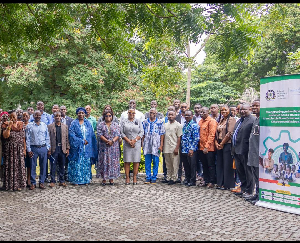
 Some of the stakeholders at the event
The National Development Planning Commission (NDPC), in partnership with Africa Human Capital Development Plus (Africa HCD+), has opened a three-day advocacy workshop to build stakeholder support and strengthen coordination for Ghana’s forthcoming National Human Capital Development Strategy.
The workshop, which began on Monday, July 27, 2026, brought together representatives from ministries, departments and agencies (MDAs), metropolitan, municipal and district assemblies (MMDAs), civil society organisations, development partners, academia and other key stakeholders to strengthen advocacy and foster collaboration towards the development and implementation of Ghana’s National Human Capital Development Strategy.
Delivering the opening remarks, the Director-General of NDPC, Dr Audrey Smock Amoah said the workshop was designed to strengthen political, institutional and public support for Ghana’s human capital agenda.
She noted that junior high school and senior high school enrolment had declined to 58.8 percent and 34.5 percent respectively, while unemployment stood at about 13 percent in the third quarter of 2025.
She further indicated that child stunting remained at 17.4 percent, with anaemia affecting nearly half of children under five.
She stressed that the country’s human capital policy must bridge education, skills development and employment to drive national development saying, “Human capital policy must therefore connect what happens in the classroom and training centres with what happens in the labour market and the wider economy,” she said, adding that advocacy should be seen as a core implementation tool rather than an afterthought.
Delivering a solidarity message, the Chief Executive Officer of Africa HCD+, Madam Finda Koroma, described the workshop as the organisation’s first advocacy engagement in Ghana noting that it builds on earlier collaboration with the Ghana Statistical Service on human capital indicators and ongoing support to NDPC in developing the National Human Capital Development Strategy.
Madam Koroma indicated that Ghana’s World Bank Human Capital Index score stood at 0.45, while the country’s Human Development Index ranking was 143rd out of 193 countries. She added that the inequality-adjusted Human Development Index declined to 0.399, underscoring the need for sustained investment in human capital.
“A technically strong strategy is therefore necessary, but it’s not sufficient. It must be understood, communicated, financed, owned and defended,” she said, stressing that Ghana’s strategy would be tailored to its unique context rather than replicate approaches adopted in countries such as Nigeria and Sierra Leone.
Also addressing participants, Louis Omar Coo of the Office of the President’s 24-Hour Economy Secretariat said the proposed human capital strategy aligns with the Secretariat’s Aspire24 Skills Programme.
He observed that more than 70 per cent of Ghanaian firms struggle to recruit skilled labour, while fewer than 20 per cent of young people possess digital proficiency, highlighting the urgency of investing in skills development.
AM
Watch as court takes over Cheddar’s prime property on Osu Oxford street
No contradictions in Finance Minister's Mid-Year Budget presentation - Majority Leader
Afenyo-Markin responds to Finance Minister's 2026 Mid Year Budget Review presentation
Ghana's recovery due to superior economic management - Ato Forson
Majority, Minority chant 'Free Wontumi', 'Bring Ken Back' after 2026 mid year budget review

Copyright © 1994 - 2026 GhanaWeb. All rights reserved.










