



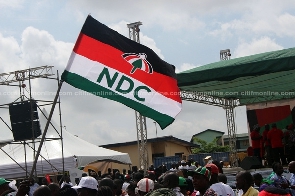
 Flag of the National Democratic Congress (NDC)
Concerns over political coordination and leadership in the Oti Region are reportedly growing, with some Members of Parliament (MPs) and supporters of the governing National Democratic Congress (NDC) calling for improved collaboration between the Regional Minister, lawmakers and the party’s grassroots structures.
At the centre of the concerns is Oti Regional Minister John Kwadwo Gyapong, whose approach to political and administrative matters in the region has reportedly generated disagreements among some NDC MPs and party supporters.
Sources familiar with developments in the region claim that relations between the minister and several MPs have become strained, with some lawmakers alleging that their concerns and contributions to regional development and party activities are not receiving adequate attention.
One constituent, who spoke on condition of anonymity, alleged that the minister’s approach was creating difficulties for some lawmakers in their constituencies.
According to them, there are concerns that political successes in the region could increasingly be associated with particular individuals rather than being viewed as the collective achievement of the government, the party and its elected representatives.
Another constituent reportedly expressed concern that disagreements among political actors could affect coordination on development initiatives and weaken party cohesion at the grassroots level.
The concerns come at a time when the NDC is seeking to consolidate its political support across the Oti Region and strengthen its structures ahead of future internal elections and national contests.
Some party members are therefore calling for greater engagement among the Regional Minister, MPs, constituency executives and other stakeholders to prevent internal disagreements from affecting the party’s work.
There are also concerns among some lawmakers that prolonged tensions could have political consequences if they are not addressed, particularly as the party prepares for future parliamentary primaries.
The MPs and party supporters who raised the concerns are reportedly urging the national leadership of the NDC to take an interest in developments in the region and encourage dialogue among the various actors.
They believe that a more collaborative approach could help address disagreements, strengthen party unity and enable political leaders to focus on development priorities affecting residents.
The allegations, however, represent the views of individuals who spoke to the reporter and could not independently be established in full. The Regional Minister and other officials whose views may differ should be given an opportunity to respond to the concerns.
Background
The Oti Region was carved out of the former Volta Region in 2018 and officially inaugurated in 2019, with Dambai serving as its regional capital.
The region covers approximately 11,000 square kilometres and shares a border with Togo. It is home to several ethnic groups, including Guan-speaking communities such as the Krachi, Nchumuru, Akyode, Adele, Buem and Nkonya, alongside Ewe, Konkomba, Kotokoli, Hausa and other communities.
Oti has nine constituencies: Biakoye, Buem, Akan, Krachi East, Krachi Nchumuru, Krachi West, Nkwanta North, Nkwanta South and Guan.
The region’s economy and development priorities include agriculture, infrastructure, education, healthcare, tourism and the development of its natural resources.
With the NDC in government, party cohesion and effective coordination between the Regional Minister, MPs and local party structures are likely to remain important to the region’s development agenda.
The emerging concerns have therefore renewed calls for dialogue and stronger coordination among the party’s regional leadership to ensure that political disagreements do not overshadow development efforts.

Copyright © 1994 - 2026 GhanaWeb. All rights reserved.










