



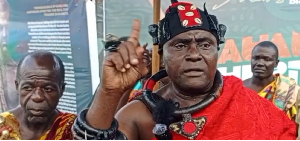
 Paramount Chief of the Nzema Kotoko Traditional Area, Tumivole Awulae Kaku Aka III
The Paramount Chief of the Nzema Kotoko Traditional Area, Tumivole Awulae Kaku Aka III, has sharply criticised the previous Akufo-Addo administration over what he described as the neglect of the Ahanta and Nzema areas in the implementation of the government’s flagship Agenda 111 hospital project, despite the region being the source of Ghana’s oil wealth.
According to the traditional ruler, it is unacceptable that communities hosting the country’s oil and gas resources were excluded from a major healthcare initiative intended to bridge Ghana’s health infrastructure gap and improve access to quality healthcare across the country.
Awulae Kaku Aka III made the remarks in an interview on Friday, July 25, 2026, during the launch of the maiden Ahanta Heritage Month celebration.
The Paramount Chief questioned why none of the constituencies within the Ahanta and Nzema enclave benefited from the Agenda 111 programme, even though the region continues to contribute substantially to the country’s petroleum revenue.
Recalling the launch of the Agenda 111 initiative, Awulae Kaku Aka III said the government had indicated that the ambitious healthcare programme would be financed through proceeds from Ghana’s oil resources, a development that gave residents of oil-producing communities hope that they would also benefit from the project.
“You see, they made it very clear that they were going to build Agenda 111 hospitals across the country. When I read about how the project was going to be funded, it was clear that the money would come from oil revenue,” he said.
He maintained that, despite the stated source of funding, not a single Agenda 111 hospital was constructed in the three constituencies that make up much of the Ahanta and Nzema enclave.
“If you start from Evalue-Ajomoro-Gwira, there isn’t even a single Agenda 111 hospital. Go to Ellembelle—there is none. Go to Jomoro, there is none. Three constituencies, yet not even one Agenda 111 hospital,” the chief stressed.
He challenged journalists and members of the public to independently verify his claims, insisting that the facts would support his assertions.
“Take it upon yourselves and investigate. If I am lying, come back and challenge me. But the facts are there—there is not a single Agenda 111 hospital in these constituencies,” he added.
The Agenda 111 programme was launched by the previous administration to address critical healthcare challenges exposed by the COVID-19 pandemic, reduce Ghana’s health infrastructure deficit, and improve access to healthcare services nationwide.
The initiative sought to construct hospitals, particularly in underserved and rural districts, as part of efforts to achieve universal health coverage and advance the United Nations Sustainable Development Goal 3 (SDG 3) on good health and well-being.
However, Awulae Kaku Aka III argued that the exclusion of the Ahanta and Nzema areas from the project undermined those objectives, especially considering the region’s contribution to the national economy through oil production.
Beyond the lack of healthcare infrastructure, the traditional ruler lamented that residents in oil-producing communities continue to endure the environmental consequences of petroleum and gas operations without receiving corresponding development benefits.
He cited communities around Atuabo and Axim, where gas flaring from the Ghana Gas processing plant has made living conditions difficult for residents.
“The people of Nzema are bearing the brunt of the hazards. The heat is unbearable. When the gas flare is on, you cannot even sleep in places like Atuabo and Axim. Yet the country continues to rake in billions of dollars from oil produced on our lands,” he lamented.
According to him, while successive governments continue to earn significant revenue from oil extracted from Nzema lands, the communities that host the resources remain deprived of critical infrastructure, particularly in healthcare.
Awulae Kaku Aka III argued that the situation reflects an imbalance in the distribution of national development projects and called for greater fairness in the allocation of public investments.
He maintained that communities contributing significantly to Ghana’s natural resource wealth deserve improved healthcare, infrastructure, and other essential public services.
The chief also emphasised that his criticism was motivated by the desire to see development in his traditional area rather than by personal interests or political considerations.
“I will not go to any minister, MP or CEO to beg for favours. As long as I have gari and beans in my house, I can feed myself. It is better to maintain my dignity than to chase after politicians for crumbs,” he said.
He urged successive governments to ensure that oil-producing communities receive their fair share of national development, stressing that the equitable distribution of public projects is essential for promoting social justice, reducing regional disparities, and ensuring that communities hosting Ghana’s strategic natural resources also benefit from the wealth generated from their lands.

Copyright © 1994 - 2026 GhanaWeb. All rights reserved.










