



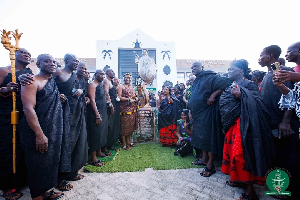
 Ohempon Dr. Yeboah Asiamah in a group picture with some chiefs at the unveiling
In a ceremony steeped in history, tradition, and reverence, Nananom of Atebubu officially unveiled the statue of the legendary warrior king, Osahene Ampon Yirenkyi, at Piabire Palace, immortalising the man who founded Saaman No. 1 and Saaman No. 2 (present-day Atebubu) and remains one of the greatest military leaders in the history of the Bono and Asante kingdoms.
The unveiling, led by HRM Ohempon Dr. Yeboah Asiamah, Paramount Chief of Atebubu and President of the Atebubu Traditional Council, was a day of solemn remembrance.
"Today, we remember and honour the sacrifice of our great forefather and founder. Today, we immortalise the name of Osahene Ampon Yirenkyi," Ohempon revealed.
A warrior whose legacy lives on
According to Ohempon, the history of Atebubu cannot be told without acknowledging the extraordinary leadership and courage of Osahene Ampon Yirenkyi.
He indicated that historically, the ancestors of Atebubu migrated from Bonoman to Adansi before eventually settling at Saman, near present-day Antoa, under the leadership of Ampon Yirenkyi.
The name Saman, Ohempon Dr. Yeboah Asiamah explained, reflects the military heritage of the people.
"The word 'Sa' in Twi denotes war. Our forefathers were renowned warriors, and because of their military exploits, the settlement became known as Sa-man (Saaman)."
He noted that, beyond military prowess, the people were equally respected for honesty and integrity, which is why the royal lineage and sole paramountcy gate of Atebubu bear the name Kyiri-Amim (now spelled ‘Kyeremim’), a reminder that deceit and dishonesty have never been hallmarks of the people of Atebubu.
The fearless Atekoasre
Ohempon recounted that Ampon Yirenkyi earned the title Atekoasre, meaning the one who laughs at rumours of war, because of his unmatched bravery. His principal weapons were the Piabire (the flaming spear) and the shield, making it especially significant that the Atebubu Palace bears that name.
"Every time we mention Piabire Palace, we are reminded of the fearless warrior who carried the Piabire into battle and defended his people without fear."
The war against Ataale Fram
Ohempon recalled that one of the defining chapters in the military history of Atebubu and Asanteman is a historical account that was recently referenced by His Majesty Otumfuo Osei Tutu II during the oath-taking ceremony of a newly enstooled chief.
In his remarks, the Asantehene acknowledged the significant role played by Kwamanhene, Saamanhene (Atebubu), Beposohene, Agogohene, Mamponhene and others in the military campaigns that shaped the history of the kingdoms.
According to Ohempon, while residing at Saaman, Osahene Ampon Yirenkyi received an urgent appeal from his brother, the Sekyere Beposomanhene, who also belonged to the Asona Clan.
The appeal was for military assistance against the feared ruler Ataale Fram VII, also known as Banka Dijatram, whose tyranny was known throughout the region and whose reign posed a serious threat to neighbouring kingdoms.
Without hesitation, Ampon Yirenkyi mobilised his warriors and marched from Saaman to Sekyere Beposo, where they established a military settlement at Kotokuom, near Beposo, in preparation for battle.
Recognising the formidable strength and numerical advantage of Ataale Fram's forces, Ampon Yirenkyi proposed an innovative surprise military strategy, known in Twi as "Yɛn fri no awuram" (literally, "Let us launch a surprise attack from the bush").
The strategy proved highly successful, enabling the allied forces to defeat and capture Ataale Fram VII. Per historical tradition, Ataale Fram VII was subsequently beheaded, and his head remains preserved at the Mampong Palace, where it maintains significance in the sacred Odwira Festival.
Following the death of Ataale Fram VII, his son, Ataale Fram VIII, also known as Gyenjawura, assumed leadership and retreated across the Sene River to establish a settlement near Kokofu in present-day Atebubu.
Determined to avenge his father's defeat, he continued his campaign of aggression against neighbouring settlements. In 1690, a second strong military alliance was formed to permanently end Ataale Fram's reign of terror.
The coalition brought together the armies of Mampong, Kumawu, Agogo, Kwaaman, Sekyere Beposo, Boɔkruwa (Kwahu), Saaman (Ampon Yirenkyi) and other States in a campaign that lasted seven years and culminated in the decisive defeat of Ataale Fram VIII in 1697.
Overwhelmed by the allied forces, Ataale Fram fled across the Volta, bringing an end to his dominance and paving the way for the eventual establishment of Saaman No. 2, present-day Atebubu, under the leadership of Osahene Ampon Yirenkyi.
The birth of modern Atebubu
Following the decisive victory, the spoils of war were shared among the allied states. Among the most treasured inheritances received by Ampon Yirenkyi and his people were the Warrior Bees, which to this day remain an enduring symbol of courage, vigilance, sacrifice, unity, and the indomitable spirit of Atebubuman.
Osahene Ampon Yirenkyi also made a bold and strategic decision that would forever change the course of our history. Rather than returning to Saaman, he declared that he and his people would cross the Sene River to establish a permanent settlement on the former lands of Ataale Fram.
This decision was not merely an act of migration; it was a deliberate military and political strategy because, in those days, territories were acquired and secured through conquest in war.
His reasoning was both simple and profound. Should Ataale Fram or any of his descendants ever attempt to reclaim the territory, Ampon Yirenkyi and his people would already be strategically positioned as the first line of defence, where they could immediately mobilise and alert their allies to resist any renewed invasion.
It was this courageous and visionary decision that led to the establishment of Saaman No. 2, a settlement that, over time, grew and evolved into the thriving traditional capital we proudly know today as Atebubu.
More than a statue
Standing before the newly unveiled monument, Ohempon reminded the gathering that the statue is not merely an artistic masterpiece but a permanent lesson in sacrifice, courage, and leadership.
He revealed that the statue of Ampon Yirenkyi standing barefoot with his spear symbolises the hardships endured by the ancestors who fought to secure the land generations now proudly call home.
"Our ancestors crossed forests, rivers, and battlefields barefoot so that we might live in peace today. Many of us would hesitate to walk even a mile without shoes. Their sacrifices should challenge us to ask what we are doing for Atebubu."
A call to build lasting legacies
The Paramount Chief challenged citizens, especially the youth, to emulate the courage, patriotism and selflessness of their ancestors by reminding the audience that power, wealth and influence are temporary, but service and legacy endure forever.
Referring to the legendary warrior, he asked: "If Ataale Fram once possessed power, where is he today? If he once possessed lands, what is his claim to them today? Legacy outlives power."
He therefore urged every citizen of Atebubu to contribute meaningfully to the development of the traditional area and to leave behind a legacy worthy of remembrance.
Preserving history for future generations
The unveiling of the statue of Osahene Ampon Yirenkyi forms part of the Atebubu Paramountcy’s broader commitment to preserving the authentic history, identity and cultural heritage of Atebubuman.
The monument will serve as a lasting educational landmark, reminding present and future generations of the courage, sacrifice and visionary leadership that laid the foundation for modern Atebubu.
Ohempon summarised the significance of the occasion in a simple but powerful statement: "Ampon Yirenkyi has done his part. Today there are no territorial wars. But we face the conquerable tyranny of economic and social woes. The question before us is this: What fight are we putting up against these enemies for the progress of Atebubu? What legacy will we leave for future generations?"

Copyright © 1994 - 2026 GhanaWeb. All rights reserved.










