



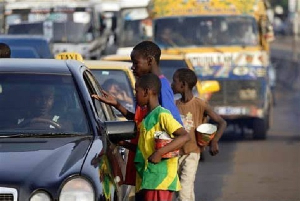
 File photo of children begging on the street
Ing Dr Peter Debrah, CEO of Pedlo Energy, has called for urgent government action over what he describes as the increasing presence of foreign children begging and selling small items on Ghanaian streets.
Dr Debrah, who has travelled extensively across the country in recent months, including along the Aflao corridor, said he had observed groups of foreign children begging around busy areas in Accra, including Panda Mall and Atomic Junction.
He believes the development deserves more than a humanitarian response and should trigger investigations into possible irregular migration, child exploitation and human trafficking networks.
“Who brought that child here? Who is responsible for the child? Where is the child living? How did the child enter Ghana, and who receives the money?” he asked.
Immigration Operations Raise Concern
Dr Debrah pointed to recent operations by the Ghana Immigration Service (GIS) as evidence that the issue requires closer attention.
In April 2026, the GIS reportedly rounded up 606 people, including 381 children, during an intelligence-led operation in Kumasi linked to exploitative migrant street-begging networks.
Another operation in Greater Accra encountered 305 West African nationals, including 113 children.
Dr Debrah said the figures should prompt authorities to investigate the networks behind the movement of vulnerable children rather than simply removing them from the streets.
“If authorities remove street beggars from our roads and, shortly afterwards, new groups appear using different methods, we need to understand the organisation behind the movement,” he said.
Focus on Aflao Border
The Pedlo Energy CEO also expressed concern about developments around the Aflao border.
He cited a June 2026 report indicating that more than 1,005 irregular immigrants had been intercepted and removed between April and June, including women and children. Some were reportedly trafficked under false promises of employment.
He said the figures do not necessarily mean Ghana has lost control of its borders, but they should prompt a review of border surveillance and intelligence gathering.
Not an Attack on Foreigners
Dr Debrah stressed that his concerns are not directed at any particular nationality.
He acknowledged Ghana's tradition of welcoming migrants and refugees and the rights of ECOWAS citizens to move within the region.
“The issue is not nationality,” he said. “The issue is whether people entering, residing and working in Ghana are being properly documented, monitored and protected, and whether vulnerable children are being exploited.”
He also cautioned against automatically linking street beggars to criminality.
“I do not believe it is responsible to say that today's street beggar will automatically become tomorrow's criminal,” he said.
However, he warned that poorly monitored migration and child exploitation could create vulnerabilities that organised criminal networks may exploit.
Call for Coordinated Action
Dr Debrah is urging the Ghana Immigration Service, Ghana Police Service, National Security, Customs Division and Ministry of Gender, Children and Social Protection to work together to assess the situation.
He wants authorities to strengthen border intelligence, improve documentation, protect vulnerable children and investigate the individuals or networks behind organised begging.
He is also calling for better intelligence sharing and accessible channels through which citizens can report suspected trafficking and child exploitation.
“Ghana must remain compassionate without becoming careless,” Dr Debrah said.
“Our borders should not become corridors for trafficking, and our compassion should not be exploited by organised networks.”
He urged the authorities to investigate emerging migration patterns before they develop into a larger national security and social challenge.
“Let us investigate today, not tomorrow,” he said.
“Because when it comes to national security, early warning is always better than late reaction.”

Copyright © 1994 - 2026 GhanaWeb. All rights reserved.










