



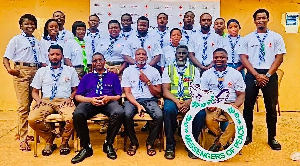
 Representatives of the Ghana Scout Association
The Ghana Scout Association (GSA) is strengthening its safeguarding systems to ensure that young people who participate in Scouting are protected from harm, treated with respect and given the confidence to take on leadership roles.
The focus formed part of a three-day Safe from Harm Capacity Enhancement Training held for Youth Advisors and Regional Safe from Harm Coordinators.
The training was organised under the Association’s Safe from Harm Capacity Enhancement Project, with support from the World Organization of the Scout Movement (WOSM) through its Messengers of Peace programme.
The initiative comes at a time when youth organisations are under increasing pressure to ensure that young people are safe in the spaces where they learn, participate and develop leadership skills.
For Ghana Scouts, the emphasis is on making safeguarding part of the organisation’s everyday work rather than treating it as a response to incidents.
Protection comes first
The first priority is to ensure that young people are protected from abuse and other forms of harm.
The training equipped regional coordinators and youth leaders with knowledge and practical skills to identify risks, prevent harm and respond appropriately when concerns arise.
This is particularly important for an organisation that brings young people together through camps, training programmes, community activities and other events.
Effective safeguarding requires more than having policies in place. Leaders and volunteers must understand those policies and know what to do when a young person needs help.
Respecting young people
The Association is also placing emphasis on how young people are treated within its structures.
Being respected means that young people should be able to express their views, raise concerns and participate in activities without fear of being ignored, ridiculed or discriminated against.
The involvement of Youth Advisors in the training provides young people with a direct role in discussions about safeguarding and the environment in which they participate.
This is important to youth development because young people are more likely to develop confidence and leadership skills when their opinions are taken seriously.
Empowerment through leadership
The third part of the approach is empowerment.
The Association wants young people to have the knowledge and confidence to understand their responsibilities, speak up when something is wrong and take part in creating safer Scouting environments.
The participation of Youth Advisors and Regional Safe from Harm Coordinators is intended to strengthen that capacity across the organisation.
The approach also recognises that young people should not only be viewed as people who need protection.
They can also contribute to identifying problems and developing solutions.
Strengthening leadership
The training was led by WOSM Consultant Eric Mwenda Gitonga of Kenya.
He was supported by Prince Akese, National Safe from Harm Coordinator; Shaibu Fenteduah Fuseini, National Youth Programme Commissioner; and Holly Boadi, National Training Commissioner.
Amina Alhassan Jerry Saliss, Chairperson of the National Youth Advisors, and Mohammed Ganiu Abdul, Vice Chairperson of the Youth Advisors, also participated.
The programme was hosted by Chief Commissioner of the Ghana Scout Association, Hilary Yaw Awusie, together with Deputy Chief Commissioner Seth Kojo Eyiah.
Their participation reflects the Association’s decision to place safeguarding within its leadership and organisational structures.
The success of the programme will ultimately depend on how the lessons are applied across Scout activities.
The Association will need to ensure that safeguarding practices are understood and followed at regional and local levels, particularly during camps, meetings and other activities involving young people.
The three priorities are closely linked.
A young person who is protected can participate without fear.
A young person who is respected knows that their voice and dignity matter.
A young person who is empowered can develop the confidence to make decisions, take responsibility and lead others.
For the GSA, building these conditions is central to its wider role in youth development and leadership training.
The objective is to make every Scout activity a place where young people can learn, participate and develop with the assurance that their safety, dignity and voices will be taken seriously.

Copyright © 1994 - 2026 GhanaWeb. All rights reserved.










