



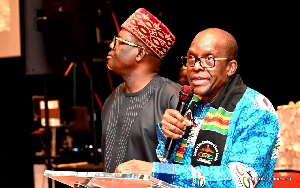
 Speaker of Parliament, Alban Bagbin
The Speaker of Parliament, Alban Bagbin, has challenged the Eʋe diaspora to move beyond sending regular remittances to families in Ghana and use their networks, skills and resources to create sustainable economic opportunities and wealth back home.
He said the Council of Ewe Associations of North America (CEANA) must evolve from mainly serving as a cultural and social organisation into a strong economic, professional and investment bridge between Ewes in the diaspora and communities in Ghana.
“The best help is not sending money every month. The best help is creating opportunity,” he said.
The Speaker made the call as Special Guest of Honour at celebrations marking the 33rd anniversary of CEANA in Washington, DC, where he urged members to use their collective strength to support development through investment, professional partnerships and businesses that could create jobs and improve livelihoods.
He said while remittances had helped families pay school fees, hospital bills and funeral expenses, as well as meet emergency needs, the diaspora could achieve a greater and more lasting impact by investing in ventures that would generate income and create opportunities for others.
“We must move our people away from the dependency syndrome,” he said, stressing that the focus should shift “from sympathy to strategy” and from short-term support to long-term wealth creation.
Bagbin challenged CEANA to build stronger links between professionals and institutions in Ghana, saying lawyers could contribute to legal and governance reforms, doctors could support health systems, engineers could help address infrastructure needs, entrepreneurs could connect Ghanaian businesses to international markets, while investors could identify and support credible projects.
He said such partnerships would allow the diaspora to contribute their knowledge, networks and expertise to national development instead of limiting their contribution to financial support for relatives.
The Speaker described CEANA as a model of how cultural identity could be used to promote national development, saying the association had demonstrated that culture could go beyond celebrations and become a tool for development and nation-building.
He recalled that CEANA began in 1993 when a small group of Ewes in Washington asked what they could do for one another and for their homeland. Over the years, the organisation had supported education, healthcare, scholarships and communities in times of crisis.
He said CEANA had therefore shown that “culture should not only bring people together to celebrate” but could also bring people together “to develop”.
Bagbin urged the association to use its 33rd anniversary to consider a major project that would leave a lasting legacy for generations.
He cited CEANA’s proposed partnership with the University of Health and Allied Sciences (UHAS) to establish a cancer research and treatment centre in Ho as an example of the type of transformational initiative the association could pursue.
According to him, such a facility could save lives, reduce the need for patients to travel outside the region for specialised cancer care and create a lasting development legacy for CEANA.
He also called for stronger economic cooperation among Ewes across West Africa, noting that the Ewe community extended beyond Ghana into Togo, Benin, Nigeria, Liberia and Côte d’Ivoire.
“Our language crosses borders. Our families cross borders. Our culture crosses borders. So why should our economic cooperation stop at the border?” he asked.
He said the shared cultural links could form the basis for a wider economic network capable of connecting businesses, professionals, investors and markets across the sub-region.
The Speaker further urged CEANA to pay particular attention to young Ewes in the diaspora and create opportunities for them to contribute their skills and ideas to development.
He said the younger generation should be taught their cultural heritage and given meaningful responsibilities within the community so they could see Africa not only as the home of their parents but also as a place where they could build businesses, develop innovations and make a lasting impact.
Bagbin said the youth should be reminded of the achievements of prominent Ewe personalities and encouraged to see greatness as part of their heritage.
He urged CEANA members to leave the anniversary celebrations with a renewed commitment to investment partnerships, professional collaboration, youth development and projects that would benefit communities in Ghana.
He said wherever members of the diaspora might live, their connection with home should remain strong, with the ultimate goal of transforming that connection into practical opportunities for development.
“Wherever life takes us,” he said, “there must always be a road that leads home.”

Copyright © 1994 - 2026 GhanaWeb. All rights reserved.










