



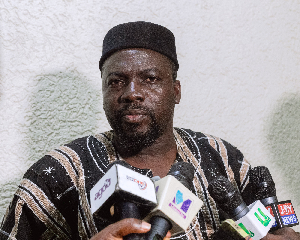
 Krachi East MCE, Safo Nketiah
The Krachi East Municipal Chief Executive (MCE), Safo Nketiah, has commended Zoomlion Ghana Limited for its interventions in the area, saying the company’s corporate social responsibility (CSR) activities are complementing the assembly’s development efforts.
Speaking to the media on the sidelines of the Parliamentary Select Committee on Sanitation and Water Resources’ engagement with Metropolitan, Municipal and District Chief Executives (MMDCEs) in Ho, Volta Region, on Saturday, September 19, 2026, Nketiah outlined a number of interventions undertaken by the assembly with support from Zoomlion.
He said the company had been a reliable partner, particularly in efforts to keep the municipality clean.
According to him, Zoomlion’s collaboration with the Krachi East Municipal Assembly had resulted in the provision of various free waste management services.
“We are collaborating very well with Zoomlion and they are helping my municipality in lifting waste and also with clean-up exercises free of charge. During the National Sanitation Day clean-up, Zoomlion supports us with waste cleaning materials,” he said.
Nketiah said the Integrated Recycling and Composting Plant (IRECOP) at Yabram had also helped address waste disposal challenges in the municipality, particularly because the area does not have a landfill site.
“But because of the IRECOP, all our waste is channelled there. And now the most important thing is that because of the IRECOP, we have very cheap organic fertilisers which are helping our farmers,” he said.
He said Zoomlion’s interventions had eased pressure on the assembly’s limited resources and called on other corporate bodies to support assemblies in addressing sanitation and water challenges.
However, Nketiah said the 10% sanitation allocation from the District Assemblies Common Fund (DACF) was inadequate to meet the growing sanitation needs of districts, making private sector support critical.
He urged the Parliamentary Select Committee on Sanitation and Water Resources to consider the interventions of companies such as Zoomlion in its assessments, saying their contributions were helping to bridge the financing gap in the sanitation and water sectors.
He also appealed to the government to increase the sanitation allocation and ensure its timely release to assemblies to enable them to plan and implement sanitation programmes effectively.
MMDAs raise sanitation concerns
The Krachi East MCE’s remarks came as MMDAs in the Volta and Oti regions raised concerns about inadequate skip and refuse containers, which they said were hampering sanitation efforts in their areas.
The issue came to the fore when members of the Parliamentary Select Committee on Sanitation and Water Resources engaged MMDCEs from the two regions in Ho as part of the Committee’s parliamentary oversight responsibilities.
Addressing the Committee, chaired by the MP for Salaga South, the District Chief Executive of North Tongu, Victoria Amefadzi Doe Yawa, said the lack of skip containers was undermining effective waste collection in the district.
“We are grateful to the Volta River Authority (VRA), which donated six skip containers to my district,” she said, adding that the assembly was in the process of procuring more.
She, however, admitted that community participation in sanitation programmes remained low despite ongoing sensitisation efforts.
The engagement also revealed concerns about the remuneration of sanitation workers employed by some assemblies.
For North Tongu, Doe Yawa disclosed that sweepers were paid between GH¢300 and GH¢350 a month, an amount Committee Chairman Oti Bless described as inadequate.
He urged the assemblies to motivate sanitation workers to improve their performance.
For other districts, including Central Tongu, Afadzato South, Akatsi North, Ketu North and Adaklu, the lack of engineered landfill sites and permanent refuse disposal facilities emerged as major concerns.
The DCE of Central Tongu, Caroline Sefanu Dogbornu, who represented the DCE, Dodzi Addison Mornyuie, said the absence of a permanent disposal site was undermining sanitation efforts in the area.
Committee examines sanitation allocation
The Committee’s engagement formed part of a monitoring exercise to establish how the assemblies were accessing and utilising the 10% sanitation allocation from the District Assemblies Common Fund.
It also sought to determine the amounts allocated for the 2025 and 2026 financial years, how much had actually been received, the sanitation programmes undertaken and the challenges affecting access and utilisation.
The MMDAs were expected to outline their sanitation challenges and explain whether the allocation was adequate to meet their needs.
One of the assemblies that presented its accounts was North Tongu. According to its presentation, the assembly received GH¢15.45 million from its 2025 DACF allocation of about GH¢21.27 million, with approximately GH¢1.55 million representing the 10% sanitation allocation.
The funds were used for interventions including the construction of six-seater water closet facilities at Mepoase Primary School and Aveime Girls School, monthly district sanitation programmes, procurement of sanitation equipment, public education, monitoring activities, the Sanitation Improvement Package and fumigation.
For 2026, the assembly reported an expected DACF allocation of about GH¢25.76 million, of which approximately GH¢8.27 million had been received by the first and second quarters. This translated into a sanitation allocation of about GH¢826,599.
Beyond expenditure, the presentations highlighted challenges affecting the assemblies’ ability to address sanitation needs. These included inadequate waste containers and logistics, irregular waste collection, limited funding for sanitation infrastructure, rapid growth in waste generation and difficulties in sustaining public participation.
The Committee also sought clarification on interventions presented, including the number and remuneration of sanitation workers, waste collection arrangements, and the progress of sanitation and water projects.
In one case, an assembly explained that 16 market sweepers had been engaged and paid between GH¢300 and GH¢350 a month to clean designated markets after market days.
Committee calls for dedicated sanitation funding
Speaking to the media on the sidelines, the Deputy Ranking Member of the Committee and Member of Parliament for Bekwai, Ralph Opoku-Adusei, said the exercise aimed to establish what the MMDAs were doing with the 10% and 20% allocations designated for sanitation and water resources respectively.
He said the engagements were also helping the Committee understand the difficulties confronting the assemblies, including limitations on their control over expenditures tied to central government arrangements such as the Sanitation Improvement Package (SIP).
Opoku-Adusei noted that while the sanitation allocation had provided assemblies with some resources to address sanitation problems, the broader challenge remained the availability of adequate and dedicated financing for sanitation.
He also called for sanitation activities such as National Sanitation Day clean-ups to be linked to the specific needs of individual districts and municipalities and assessed based on the results achieved.
The Committee is expected to continue engaging other MMDAs as it gathers information on sanitation financing, expenditure, programme implementation and challenges across the two regions before making recommendations to Parliament.

Copyright © 1994 - 2026 GhanaWeb. All rights reserved.










