



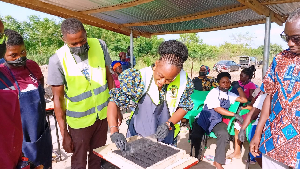
 The intervention follows concerns over the large quantities of rice residue being burnt
Rice farmers in the North Tongu and Central Tongu districts of the Volta Region have been trained to convert rice straw and other farm residues into economically useful products as part of efforts to reduce the widespread burning of rice waste and its associated health and environmental effects.
The intervention follows concerns over the large quantities of rice residue being burnt in the two districts, where rice farming is a major economic activity. According to the organisers, about 70% of the rice plant remains after harvesting and is often treated as waste and burnt on farms.
The practice releases smoke and pollutants into the atmosphere, exposing farmers and residents to health risks while also contributing to environmental degradation and climate change.
The initiative is being implemented by Community Advocacy Against Poverty (CAAP) in collaboration with Ho Technical University (HTU), with support from the Clean Air Fund.
According to the Executive Director of CAAP, Antonio Gomado, the programme has trained 52 farmers and is expected to benefit about 3,000 people directly.
The training focused on helping farmers turn rice residues into products such as charcoal briquettes, mushroom and livestock feed.
The Project Lead for CAAP, Dr Akorfa Ahiafor, said the intervention was informed by health data from the districts.
She said records from health facilities showed that the three leading diseases reported in the area were smoke-related, making it necessary to address the sources of smoke in the communities.
Ahiafor said when farmers burn rice straw, they inhale the smoke and also carry its effects back to their homes, exposing other members of their families.
She added that the smoke often spreads to neighbouring communities, meaning one person’s farming activity could expose others to health risks.
She said the resulting illnesses could lead farmers and households to spend money on hospital bills, reducing the income they earn from farming.
“Instead of the farmer using the money generated from the farm for other things, the money is used to pay for hospital bills,” she said.
Ahiafor said the project was therefore intended to change the perception that rice straw was waste and encourage farmers to see it as an income-generating resource.
She added that the project was also developing entrepreneurial skills around the rice residue value chain.
According to her, the value chain could create opportunities for people to provide baling, transportation, storage and processing services, while others could specialise in producing charcoal, livestock feed or mushrooms.
The Head of the Civil Engineering Department at HTU, Ing. Dr Patricia Asantewaa-Tannor, said students of the university had developed a practical solution to the burning of rice residues by converting them into charcoal briquettes through controlled burning.
She said the process significantly reduced the amount of smoke produced while creating a useful product for households.
She added that the charcoal briquettes had been tested and found to burn more efficiently than regular charcoal, although they took longer to ignite because of their density.
Asantewaa-Tannor said the innovation was developed by female engineering students through HTU’s Women in Engineering initiative.
Speaking to journalists, the Programmes Officer of CAAP, Evans Degboe, said the organisation’s focus was on reducing poverty, particularly in rural communities, while helping farmers find safer and more sustainable ways to improve their livelihoods.
The Country Lead for Ghana at the Clean Air Fund, Desmond Appiah, said the organisation was supporting the project because it provided an alternative to burning rice residues while creating economic opportunities for farmers.
He said converting rice straw into briquettes would provide a cleaner energy option than regular charcoal made from wood and used in households.
Appiah urged farmer groups to apply the knowledge acquired through the training and work collectively to reduce or eliminate the burning of rice residues.
He said the project was encouraging farmers in both districts to develop communal processing centres where the residues could be collected and converted into useful products.
He said the approach would be more effective through cooperatives because individual farmers could continue to be affected by smoke from neighbouring farms.
Appiah also said some aggregators who purchase rice in the area had expressed interest in commercially viable products that could emerge from the project.
He said the immediate objective was to demonstrate to farmers that rice residue could be used productively instead of being burnt, while subsequent efforts would focus on developing markets for the products.
The project organisers said the initiative was expected to contribute to improved air quality, reduce smoke-related illnesses and create additional income opportunities for farming communities while helping to address the environmental effects of open burning.

Copyright © 1994 - 2026 GhanaWeb. All rights reserved.










