



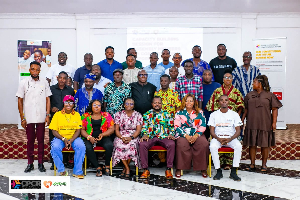
 The engagement formed part of efforts by the Citizens Platform on Constitutional Reform
The Centre for Democratic Development (CDD-Ghana), in partnership with the LoveAid Foundation and the Citizens Platform on Constitutional Reform (CPCR), has engaged Assembly Members in the Ho Municipality on proposed constitutional reforms and their implications for local governance and national development.
The capacity-building session, held at the SkyPlus Hotel in Ho, brought together Assembly Members to examine the recommendations of the Constitutional Review Committee (CRC), chaired by Professor H. Kwasi Prempeh, as well as the government’s position on the proposed reforms.
The engagement formed part of efforts by the Citizens Platform on Constitutional Reform, a coalition of more than 100 civil society organisations, to sensitise citizens and key stakeholders to the constitutional review process and encourage their participation.
Princess Lovia Tetteh, Executive Director of the LoveAid Foundation and a member of the Citizens Platform and Youth Platform on Constitutional Reform, said Assembly Members were important stakeholders because of their direct connection with communities.
She said the engagement was intended to help Assembly Members understand the recommendations, form informed positions, return to their electoral areas to educate constituents and gather their views on the proposed changes.
According to her, the Constitutional Review Committee presented a report that had been synthesised by the organisers into key thematic areas to make it easier for stakeholders to understand and discuss.
“The constitutional review process engaging stakeholders is not a one-time thing; it is a continuous dialogue,” she said, stressing that the Presidency, the implementation committee, civil society organisations and citizens all had roles to play.
She said the involvement of Assembly Members was particularly important because constitutional reforms relating to local governance could directly affect communities and the way development was delivered at the grassroots.
Assembly Members raise concerns over local governance
The discussions covered several issues, including the proposed four-year or five-year presidential term, democratic governance and accountability, local government reforms, citizen participation and the implementation of recommendations requiring constitutional amendments.
Mac-Billions Bansah Dickson, Assembly Member for the Sokode-Gbogame Electoral Area, raised concerns about the distribution of the District Assemblies Common Fund.
He argued that the existing allocation did not adequately reflect differences in the capacities of assemblies to generate revenue and their development needs, particularly in deprived municipalities.
He also expressed support for the presidential appointment of MMDCEs, arguing that collaboration between Regional Ministers, MMDCEs and Assembly Members could help ensure the effective implementation of government policies.
The Presiding Member of the Ho Municipal Assembly, Mawunyo Agbe, called for consideration of an age limit for the Speaker of Parliament.
He questioned the implications of a situation where a 21-year-old Speaker, who meets the constitutional age requirement for Parliament, could potentially assume presidential responsibilities in the absence of the President and Vice-President.
He urged stakeholders to examine the issue as part of the review process.
Youth demand greater participation
Christopher Wisdom Penu of the Youth Platform on Constitutional Reform called for greater youth participation in the process and urged the government to make the review transparent and avoid decisions that could polarise the exercise.
He said although young people welcomed the establishment of the CRC, they were disappointed by the government’s position paper on the committee’s recommendations.
“We expect the government to make the process as transparent as possible and give young people a seat at the table where they make decisions,” he said.
Penu said the Youth Platform wanted the minimum age for presidential candidates to be reduced from 40 to 30 years.
He noted that while the CRC had proposed reducing the age to 35, the youth considered 30 years more appropriate to create opportunities for younger Ghanaians to participate in national leadership.
He also said the platform supported the non-partisan election of Metropolitan, Municipal and District Chief Executives (MMDCEs), allowing citizens to directly choose leaders for their assemblies.
Penu further advocated greater accountability for the presidency, including the payment of taxes by the President, arguing that leaders should also demonstrate the responsibilities expected of ordinary citizens.
He said some of the proposed reforms would require a referendum and therefore called for extensive grassroots mobilisation to ensure citizens understood the issues before voting.
Participants were encouraged to return to their electoral areas, engage constituents and bring their feedback into subsequent consultations.
The organisers said such grassroots engagements would help ensure that the final constitutional reforms reflected the views and aspirations of citizens across Ghana.

Copyright © 1994 - 2026 GhanaWeb. All rights reserved.










