


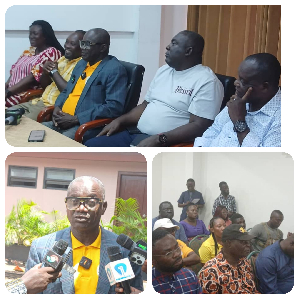
 Collage of Secretary Michael Adu-Gyamfi and the GNASSM election committee
Members of the Ghana National Association of Small Scale Miners (GNASSM), have called on the government to urgently overhaul the country's land administration and mining architecture, demanding the decentralization of licensing processes and the formalization of small-scale miners to end chronic operational delays.
Addressing the media during the official announcement of the association's 2026 internal election timetable, Mr Adu- Gyamfi revealed that administrative bottlenecks have left permit applications hanging for over three years, severely frustrating law-abiding operators.
"It is very sad that few people are licensed due to administrative bottlenecks".
The association emphasized that while the government has maintained an open posture toward dialogue, an urgent shift is needed from policy discussions to actual implementation on the ground.
Addressing reports that the government intends to restructure the landscape architecture of mineral administration, the association stressed that any new framework must prioritize local community participation to prevent conflicts between host communities and external license holders.
"We have been advocating that the processing of licenses must involve the local community. We must do away with a centralized system where someone living in Manso sees an outsider arrive holding a centrally issued license, claiming the exclusive right to mine in their community." He stressed.
While acknowledging that delays in issuing licenses might stem from ongoing governmental consultations over land reforms, the association urged authorities to be forthcoming to give affected operators clarity and closure.
Reacting to recent commentary by the Deputy Lands Minister on widespread unreclaimed mined lands, the association maintained that environmental reclamation is a mandatory, non-negotiable phase of responsible mining.
However, the GNASSM leadership cautioned against broad-brush categorizations that brand all small-scale miners as illegal "galamsey" operators, arguing that formalization, rather than criminalization, is the key to environmental sustainability.
"When people talk about galamsey, we need to look at it critically. If someone is engaged in small-scale mining, you have to formalize them. What we need to focus on is promoting responsible and sustainable mining practices."
The association argued that labeling small-scale miners as outlaws actively undermines environmental conservation effort.
"If you brand me as an illegal miner doing illegal business, do you expect me to reclaim the land voluntarily, knowing I will be arrested at that point? Let us formalize small-scale miners by enforcing responsible methods that is the true path to saving our environment." He said.
Meanwhile, the policy demands coincided with the official launch of the association's nationwide election timetable, which will usher in new executives for a four-year term following a prolonged administrative hiatus.
Michael Adu- Gyamfi, Ashanti chapter secretary of the GNASSM explained that the internal elections constitutionally mandated every four years, were delayed for nearly seven years to allow the organization to compile a verified digital database and eliminate historical reliance on improvised voting registers.
"Considering our previous election was almost seven years ago, the association felt we needed to get our database right. We have successfully registered our members across Ghana, and we are now fully ready to conduct our elections." He said.
The association outlined the roadmap for the 2026 internal polls as follows:
Zonal Elections: November 13
District Elections: December 20
National Executive Elections: December 21
With the digital membership register now fully operational, leadership stressed that voting and contesting will be strictly restricted to registered members in good standing to guarantee maximum transparency and credibility.
He urged members across all zones and districts have been urged to participate actively in the upcoming polls to establish a fully fledged executive body to lead the association for the next four years.

Copyright © 1994 - 2026 GhanaWeb. All rights reserved.










