


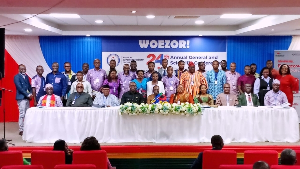
 Some leaders and members of the Medical Superintendents Group in a group photograph
The Medical Superintendents Group has appealed to the government and the National Health Insurance Authority (NHIA) to urgently release funds owed to hospitals, warning that delays in reimbursement are creating financial difficulties for health facilities and threatening the delivery of essential services.
Speaking at the 24th Annual General and Scientific Conference of the Medical Superintendents Group in Ho, the Volta Regional capital, the group’s National President, Dr Eric Sarpong-Ntiamoah, said several health facilities had between two and four months of claims outstanding following the transition between health information management systems.
He said the delays had made it difficult for hospitals to settle debts owed to suppliers and maintain essential services.
The conference was held under the theme, “Leadership and Innovation in Free Primary Healthcare Towards Achieving Universal Health Coverage in Ghana: The Role of Medical Superintendents”. It was sponsored by Tobinco Pharmaceuticals Limited.
Dr Sarpong-Ntiamoah urged the Minister of Finance, through the Minister of Health and the Director-General of the Ghana Health Service (GHS), to facilitate the prompt payment of outstanding claims.
“These are monies that we should have gotten from services that are already delivered, so suppliers are chasing us. We humbly appeal for the payment of these monies,” he said.
He explained that hospitals had already provided services, dispensed medicines and used essential medical supplies, but the corresponding revenue remained unpaid.
He warned that prolonged delays could affect the availability of medicines, the supply of consumables and the maintenance of equipment, potentially putting patients at risk.
He therefore called on the NHIA to reimburse claims already submitted by health facilities to enable them to replenish supplies, meet financial obligations and sustain healthcare delivery.
Dr Sarpong-Ntiamoah also urged medical superintendents to ensure that outstanding claims were processed and submitted promptly, stressing that health facilities must fulfil their responsibilities to support timely reimbursement.
GHIMS transition
On the transition from the Lightwave Health Information Management System (LHIMS) to the Ghana Health Information Management System (GHIMS), he acknowledged improvements since the new system was introduced but said some technical and operational challenges remained.
He recalled that the group’s current national executive committee was sworn into office on October 18, 2025, but claims processing and access to patient information were disrupted the following day.
The transition subsequently affected clinical documentation, pharmacy operations, inventory management, billing and National Health Insurance Scheme (NHIS) claims reporting in several facilities.
Although many of the initial challenges had been addressed through engagements with the relevant authorities, he said GHIMS remained a work in progress.
He proposed the establishment of a technical working group comprising representatives of the Ministry of Health, the Ghana Health Service, the GHIMS technical team and the Medical Superintendents Group to identify outstanding problems, assign responsibilities and agree on timelines for resolving them.
“We are not asking merely for the opportunity to point out what is wrong. We are asking for the opportunity to sit at the table and help make it right,” he said.
Conditions of service and health insurance tariffs
Beyond the digital health system, Dr Sarpong-Ntiamoah called for improved conditions of service for medical superintendents, arguing that their remuneration should reflect their professional qualifications and managerial responsibilities.
He said specialists and consultants serving as medical superintendents should receive salaries corresponding to their technical grades, alongside appropriate allowances for their administrative duties.
He also raised concerns about penalties imposed on some facilities over alleged non-disclosure of information under the Right to Information framework. He argued that such matters should be addressed through the Director-General of the Ghana Health Service.
On health insurance tariffs, he warned that excluding basic surgical procedures, including hernia operations and caesarean sections, from reimbursement for polyclinics could deprive communities of essential healthcare.
He cautioned that the situation could contribute to increased maternal mortality if access to necessary services was not addressed.
Dr Sarpong-Ntiamoah also questioned fees charged by the Medical and Dental Council for training house officers, arguing that hospitals already provided the facilities and supervision required for medical training.
He cited the placement of nursing, midwifery and pharmacy interns in hospitals as grounds for reviewing the charges imposed on facilities that train house officers.
Support for Free Primary Healthcare
On the proposed Free Primary Healthcare policy, Dr Sarpong-Ntiamoah said medical superintendents were ready to support its implementation, particularly through referrals and continuity of care beyond the polyclinic level.
However, he stressed that hospitals would need adequate human resources, equipment, medical supplies and other logistics to manage any increase in demand.
He also called for public education to clarify the scope of the free primary healthcare package and ensure patients understood the payment arrangements for services beyond its coverage.
The Medical Superintendents Group said addressing these concerns would strengthen hospital operations and improve access to quality healthcare, particularly for vulnerable communities.

Copyright © 1994 - 2026 GhanaWeb. All rights reserved.










