


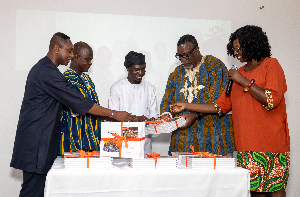
 Nii Noye said he spent more than a year documenting the festivals to promote tourism
Ghana’s rich cultural heritage, expressed through festivals and other traditions, has been preserved for centuries, largely through oral accounts. However, with aspects of the country’s culture gradually being lost due to inadequate documentation, photographer Andrew Nii Noye has embarked on a project to document Ghana’s festivals.
His photobook, titled From Cape Coast to Dagbon: A Visual Journey Through Ghana’s Heritage, captures the celebrations and cultural significance of two prominent festivals: the Damba Festival in Dagbon and the Oguaa Fetu Afahye in Cape Coast. The book was edited by Dr Patricia Serwaa Afrifa, who holds a PhD in African Studies from the University of Ghana, Legon.
Nii Noye said he spent more than a year documenting the festivals to promote tourism, support cultural education and preserve Ghana’s heritage for future generations.
“I wanted to start a project documenting some of our festivals and cultural activities to augment the information that is already out there. This is to support educational institutions, international cultural organisations in the country, and promote tourism as well,” he said at the launch, held at the British Council in Accra on Thursday, October 15, 2026.
He explained that the project seeks to highlight important cultural stories that are often overlooked.
“When I started, I realised that there is a lot of information out there that we are not giving attention to. We attend events and we simply look at what is happening. But beyond the clothing, beyond the drumming, beyond the dancing, there are stories behind them,” he said.
He added that the photographs he took, alongside the information gathered during the project, would help tell these stories and provide a deeper understanding of the traditions.
The book brings together photographs from the Oguaa Fetu Afahye in Cape Coast and the Damba Festival in Dagbon. Although the festivals originate from different parts of Ghana, they reflect the identity, history and values of the communities that sustain them.
Having documented the 2024 Damba Festival during the reign of the late Yaa Naa Mahama Abukari II, Nii Noye said the photographs had acquired greater historical significance following the traditional ruler’s passing.
“Since the passing of His Royal Majesty, Yaa Naa Mahama Abukari II, this book has taken on an even deeper meaning. I had the privilege of documenting the Damba Festival during his reign. Some of the photographs in this book now preserve moments from a period in Dagbon’s history that has passed. These images remind us that photography can preserve memories long after the moment itself is gone,” he said.
Speaking at the event, Deputy Chief Executive Officer of the Ghana Tourism Authority, Gilbert Abeiku Aggrey, popularly known as Abeiku Santana, emphasised the need for collective efforts to preserve Ghana’s cultural heritage.
He said photography was an effective way to tell stories and pass cultural knowledge on to future generations, but noted that Ghana had not done enough to document its history visually.
Abeiku Santana also highlighted the significance of Kente as a cultural symbol associated with Ghana, urging the public to appreciate its historical and cultural value beyond its use as a traditional fabric.
He said the colours and weaving patterns of Kente reflected the country’s diversity, inclusion and unity.
He further warned that some cultural traditions could disappear if deliberate efforts were not made to document and preserve them, commending Nii Noye for undertaking the project.
“We have a lot to tell but we don't have anything to show, and pass it to our generation. We are now competing with the Internet age for every information,” he said.
He added that the growing reliance on the internet and artificial intelligence for information made it increasingly important for Ghanaians to document their own history and heritage.
The Member of Parliament for Nhyiaeso and former Deputy Minister for Finance and Trade, Dr Stephen Amoah, also commended Nii Noye for investing his time and resources in documenting the country’s cultural traditions.
Having mentored the photographer for several years, Dr Amoah described his commitment to the project as commendable, noting that the initiative could contribute to the development of Ghana’s creative arts sector and benefit future generations.
He praised Nii Noye’s determination and commitment to projects that seek to make a positive contribution to society.
The Chairperson of the Governing Board of the National Youth Authority, Julian Mawuse Cobbinah, also called for greater efforts to document Ghana’s history and culture.
He raised concerns about how foreign cultural influences were shaping the tastes and perceptions of young people, including their attitudes towards food and other aspects of everyday life.
Cobbinah stressed that documenting and teaching Ghana’s cultural heritage could help strengthen national identity, build social resilience and encourage greater appreciation of local traditions.
He also called for ways to promote and commercialise Ghanaian culture while preserving its authenticity and significance.
The launch of the photobook was supported by the British Council in Accra. Also present were the Country Director of GIZ, Sandra Retzer, and the National Programme Officer for Culture at the UNESCO office in Accra, Carl Ampah.
The event was attended by other traditional leaders, including Nana Obiri Aduama I, Nkodohen of the Oguaa Traditional Area, and Asafoatse Annang Tokodia V of the Kpone Traditional Area.

Copyright © 1994 - 2026 GhanaWeb. All rights reserved.










