


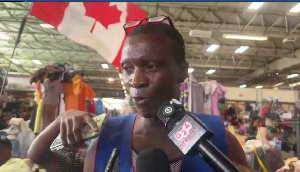
 A trader speaking to the media
Tailors at the Kejetia Market in Kumasi say their businesses are struggling due to the increasing use of imported school uniforms, which they claim has displaced local producers from contracts previously awarded under the Free Senior High School (Free SHS) programme.
The traders say the shift towards uniforms imported from China and supplied through schools has reduced demand for their services and affected their livelihoods.
One of the tailors, Emmanuel Asante speaking during an interaction with the Member of Parliament for Afigya Kwabre North and Ranking Member of Parliament’s Energy Committee, Collins Adomako Mensah, at the market, said the situation had forced them to consider seeking the intervention of the Education Ministry.
“Business has been slow. We plan to seek audience from the Education Minister for his intervention,” Asante said.
He explained that the Free SHS programme had previously created opportunities for local tailors through uniform contracts, while also helping families who could not afford to purchase school uniforms for their children.
“The Free SHS helped we the tailors because we were giving a lot of contracts and it helped the vulnerable who hitherto could not get money to purchase uniforms for their wards,” the tailor said.
However, the tailor alleged that schools had now taken over the supply of uniforms and were importing them from China, leaving local garment producers with fewer opportunities.
The trader also complained that parents were being directed to buy the imported uniforms, which they described as expensive.
“Now the schools have taken over our jobs and now import these uniforms from China and this has affected our business. And at the same time they have ordered parents to buy the imported uniforms and this is killing us,” the tailor said.
Dumsor worsens business conditions
The tailors also cited electricity outages as another challenge affecting their operations, saying they were sometimes unable to use generators when power supply was interrupted.
According to the trader, market authorities or those managing the generator supply had restricted the use of the backup power by tailors because their machines were considered to consume too much fuel.
“Now with the power outages whenever the gen set is switched on, we are not connected because they say our machines will consume the fuel and so the ‘dumsor’ is also affecting us. It is really affecting us,” the trader said.
The tailors are appealing for government intervention to address the challenges, particularly the loss of uniform contracts and the cost of imported school uniforms.
They say restoring opportunities for local garment producers could help sustain their businesses and support livelihoods at the market.
Political Intervention:
Addressing a gathering of affected traders, shop attendants, and members of the press, Collins Adomako-Mensah expressed deep sympathy over the harrowing accounts presented to him, characterizing the current predicament as a critical strain on local enterprise.
“Listening to these stories firsthand paints a grim picture of what our business community is enduring,” Adomako-Mensah stated.
He said, “I urge all traders to exercise calm as we navigate these difficult times. From our end, the Parliamentary Minority will utilize every legislative channel available to apply relentless pressure on the government to restore grid stability and salvage commercial operations.”
Injecting a political dimension into the discussion, the MP added, “I am confident the public misses the governance of the New Patriotic Party (NPP)”.
He stressed that, “history shows our administration consistently delivered superior management across all sectors of the economy, particularly in energy resilience.”

Copyright © 1994 - 2026 GhanaWeb. All rights reserved.










