



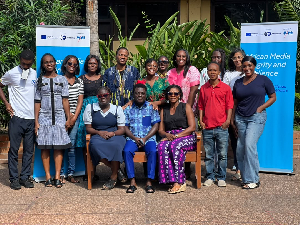
The Bloggers Association of Ghana has joined journalists and media practitioners from leading media organisations across the country for a five-day training organised by DW Akademie to strengthen gender-sensitive and responsible reporting.
The training, held from September 7 to 11, 2026, formed part of the European Union-funded African Media Integrity and Resilience (AMIR) Programme – Ghana, which seeks to strengthen the professionalism, safety, integrity and resilience of Ghana’s media ecosystem.
The Gender-Sensitive Reporting training brought together journalists, broadcasters and digital content creators to examine how gender perspectives can be incorporated into everyday journalism and how the media can better reflect the experiences and voices of marginalised groups.
Participants were drawn from a wide range of media organisations and platforms, including the Daily Graphic, Ghana News Agency (GNA), ModernGhana, TV3/Media General, Ghana Broadcasting Corporation (GBC), GTV, Attractive Media and the Bloggers Association of Ghana.
The participation of bloggers and digital media practitioners underscored the growing influence of online platforms in shaping public opinion and driving conversations, particularly among young people.
Gender-sensitive reporting as better journalism
Senior Consultant at DW Akademie and trainer, Sheila Mysorekar, stressed that gender-sensitive reporting should not be treated as a specialised form of journalism that is separate from everyday news gathering and reporting.
“Gender-sensitive reporting means, first and foremost, good reporting. It is basically putting on a gender lens to any kind of reporting to make it better and more inclusive,” she said.
During the five-day workshop, Mysorekar and Isaac Kaledzi, a correspondent with Deutsche Welle (DW), took participants through practical approaches to identifying bias and improving the quality of news coverage.
The training covered a range of issues, including the use of gender-sensitive language, diversity in sourcing, responsible selection of images, inclusive storytelling and solution-oriented reporting.
Participants were also encouraged to critically examine assumptions and stereotypes that can influence the way stories involving women, men, children and other marginalised groups are reported.
The facilitators emphasised the need for journalists and content creators to go beyond simply identifying people as subjects of stories and instead create opportunities for those affected by issues to contribute their perspectives and experiences.
This approach, participants were told, can help produce stories that are more balanced, representative and reflective of the realities of society.
Training strengthens media resilience
The workshop forms part of wider efforts under the AMIR Programme to strengthen Ghana’s media sector amid growing challenges, including disinformation, digital threats, legal intimidation and sustainability pressures.
The broader programme focuses on capacity building for journalists, support for community media, media literacy for citizens and international peer learning aimed at promoting sustainable improvements within the media sector.
Project Manager for the African Media Integrity and Resilience Programme, Cecil Ato Kwamena Dadzie, said the training was designed to equip journalists and media practitioners with practical tools to report gender-related issues fairly, accurately and responsibly.
He said the initiative also sought to ensure that marginalised voices receive greater visibility in the media.
“The media plays a critical role in shaping public perceptions and influencing social change. Through this workshop, we aim to strengthen journalists’ capacity to report gender issues accurately, fairly, and responsibly, while promoting inclusive storytelling that reflects the experiences and voices of all members of society,” he said.
Mr Dadzie said DW Akademie’s continued commitment to strengthening the capacity of journalists could contribute to creating a more inclusive media environment while supporting broader efforts towards gender equality and social justice.
He expressed appreciation to the European Union for funding the AMIR Programme, noting that the support was making it possible to implement initiatives aimed at promoting inclusive and responsible journalism across Africa.
Bloggers urged to promote responsible digital storytelling
The President of the Bloggers Association of Ghana, Andre Mustapha Nii Okai Inusah, popularly known as Attractive Mustapha, welcomed the training and described it as a valuable opportunity for journalists and bloggers to improve the quality and responsibility of their work.
He noted that bloggers and digital content creators had become important players in shaping public conversations, especially as more people increasingly rely on online platforms for news, information and commentary.
According to him, the principles of gender-sensitive reporting should therefore extend beyond traditional newsrooms to blogs, social media platforms and other forms of digital content.
He said applying gender-sensitive principles to digital journalism and online content creation could help reduce harmful stereotypes, promote balanced representation and encourage more constructive public discourse.
Mr Inusah said the knowledge acquired from the training would benefit not only the individual participants but also the wider Ghanaian media industry and society.
He encouraged journalists and bloggers to be more conscious of the language they use, the sources they select and the images they publish, particularly when reporting on sensitive issues involving women, children and other vulnerable or marginalised groups.
He further noted that digital platforms have the ability to amplify voices that may otherwise receive little attention, but warned that the same platforms could also reinforce stereotypes and misinformation when content creators fail to apply professional and ethical standards.
He said the training had therefore provided an opportunity for bloggers and journalists to reflect on their responsibilities as influential voices in society.
Diversity in participation
The involvement of professionals from different areas of Ghana’s media landscape provided an opportunity for participants to share experiences and discuss how gender-sensitive reporting can be applied across various platforms.
Traditional news organisations, television broadcasters, online news platforms and bloggers were able to examine the different challenges they encounter in reporting issues related to gender.
The cross-section of participants also highlighted the changing nature of Ghana’s media environment, where traditional journalism increasingly overlaps with digital publishing, social media and independent content creation.
Participants discussed the importance of diversifying sources and ensuring that women and other underrepresented groups are not excluded from stories simply because they are often harder to reach or less frequently featured as expert sources.
They were also encouraged to question stereotypes and avoid framing stories in ways that could reinforce harmful assumptions about particular groups.
Building a more inclusive media landscape
The training ultimately reinforced the principle that gender-sensitive journalism is not about giving preferential treatment to one group.
Rather, it is about improving the quality of journalism by ensuring that reporting is fair, accurate, diverse, balanced and reflective of the experiences of society as a whole.
For bloggers and digital content creators, the lessons also have implications for the rapidly changing online information environment, where stories can reach large audiences within a short period and where poorly framed content can quickly spread harmful stereotypes.
By encouraging media professionals to question assumptions, diversify their sources, use appropriate language and give greater attention to marginalised voices, the training sought to contribute to a media environment that better reflects Ghanaian society.
At the end of the five-day programme, participants left with a renewed commitment to approaching gender-related stories more consciously and responsibly.
The participation of the Bloggers Association of Ghana further demonstrated the importance of extending professional development and responsible journalism practices beyond traditional newsrooms to the growing community of bloggers and digital content creators.
Through initiatives such as the Gender-Sensitive Reporting workshop, the AMIR Programme continues to support efforts to build a stronger, more resilient and inclusive Ghanaian media sector—one capable of informing citizens responsibly, challenging harmful narratives and creating space for voices that are often overlooked.

Copyright © 1994 - 2026 GhanaWeb. All rights reserved.










