



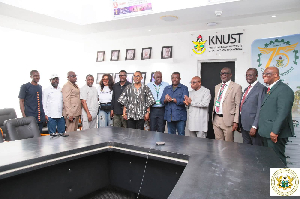
The government is shifting its One Million Coders Programme (OMCP) at the Kwame Nkrumah University of Science and Technology (KNUST) from first-year students to third- and final-year students to equip graduates with job-ready digital and artificial intelligence skills before leaving the university.
The Minister for Communications, Digital Technology and Innovations, Sam George, said the adjustment was intended to bridge the gap between digital skills training and employment by ensuring students could apply their knowledge as they entered the job market.
Speaking during a working visit to the programme’s training centres at KNUST, Mr George announced plans to provide the university with an additional 2,000 laptops to expand access to the programme and strengthen its implementation.
The government had earlier supplied 500 laptops to support the university’s training centres.
Mr George explained that training students in their first year could create a gap between completing the programme and applying the skills in the workplace if they did not actively develop those skills in subsequent years.
“If a Level 100 completes the programme today and decides not to do anything between Level 300 and 400, by the time they are leaving the university, there is a lag between the training and the implementation,” he said.
He added that the government was working with a team from Harvard University to conduct a skills gap analysis to ensure the programme reflected employers’ needs and the evolving demands of the artificial intelligence industry.
The Minister also called on universities and traditional authorities to take the lead in developing Ghanaian AI language models, warning that indigenous African languages could be marginalised if AI systems were developed without sufficient local knowledge.
He identified KNUST as well-positioned to lead the development of AI language models for Twi, given its location in the Ashanti Region and the role of traditional authorities in preserving local languages and cultural knowledge.
“Ghana must build the capacity to develop its own language models rather than depend entirely on foreign institutions that may not fully understand the country's linguistic nuances,” Mr George said.
The Vice-Chancellor of KNUST, Professor Christian Agyare, welcomed the government's commitment to moving from policy formulation to implementation, assuring the Minister that the university had the expertise and infrastructure to support the programme.
Professor Agyare disclosed that the university had enrolled about 1,444 participants in the training, describing the proposed shift towards third- and final-year students as a practical approach to preparing graduates for the job market.
He said the university was taking steps to ensure the laptops were properly managed and that students without personal devices could access the programme through designated university centres.
According to him, KNUST intended to distribute the additional laptops across its various centres to facilitate participation, while leveraging its technical expertise to support the training.
He added that the initiative aligned with efforts to reduce unemployment by equipping students with digital skills that could help them secure jobs or create opportunities for themselves after graduation.
The One Million Coders Programme forms part of the government's broader drive to expand digital skills training and prepare young people for opportunities in Ghana's growing digital economy.
Story by: Andre Mustapha Nii Okai Inusah
Popularly Known As: Attractive Mustapha
Email: attractivemustapha@gmail.com
Contact Number 0244259564

Copyright © 1994 - 2026 GhanaWeb. All rights reserved.










