



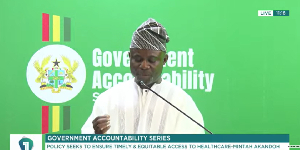
Health Minister Kwabena Mintah Akandoh has outlined the full scope of Ghana’s primary healthcare policy, describing it as the backbone of a resilient health system capable of meeting most of the country’s medical needs.
Speaking at the Government Accountability Series in Accra on Monday, April 13, the Health Minister said the policy is designed to ensure that every Ghanaian who visits a primary health facility can access a broad range of essential services.
“In clear terms, it ensures that when a Ghanaian visits a primary health facility, they will be able to receive a range of essential services, and this includes routine screening for conditions such as hypertension, diabetes, obesity, and mental health screening,” he said.
He explained that the services extend beyond basic treatment to include cancer screening and comprehensive maternal and child healthcare, such as antenatal and postnatal care, immunisation and growth monitoring.
According to him, the policy also places strong emphasis on prevention and public health education, including counselling on non-communicable diseases, family planning, immunisation, safe water practices, and menstrual hygiene.
“It also includes cancer screening, maternal and child health services such as antenatal care, postnatal care, immunisation and growth monitoring as well as health promotion activities such as NCD risk counselling, promotion of family planning, immunisation, safe water management, menstrual hygiene and the treatment of common conditions like malaria, diarrhea and respiratory infections,” he added.
The Minister noted that treatment at the primary level will also cover common illnesses such as malaria, diarrhoea, and respiratory infections, alongside basic emergency care, counselling, and referral services where necessary.
“These are the services that address the majority of health needs in our population, and surveys have it that about 80% of our health needs are the primary healthcare,” he stated.
He stressed that strengthening primary healthcare is critical to improving the entire health system, arguing that getting it right at the foundational level would significantly ease pressure on higher-level facilities.
“So if we get our primary healthcare right, what it means is that we are getting the system right and we will have a resilient health sector and health system,” he said.

Copyright © 1994 - 2026 GhanaWeb. All rights reserved.










