



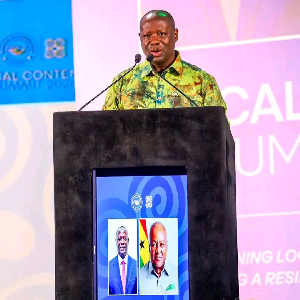
Emmanuel Armah-Kofi Buah, the Lands and Natural Minister of Ghana, has issued a strong warning against the practice of “fronting” in Ghana’s mining sector, describing it as “a theft of opportunity” that undermines the country’s quest for genuine local participation in the extractive industry.
Addressing participants at the maiden and historic ongoing Local Content Summit in Takoradi on Wednesday, February 18, 2026, Armah-Kofi Buah declared that Ghana had reached a turning point in its economic journey and must now take full control of its mineral wealth.
"Ghana has reached the place where we can drive the bus,” he said, urging stakeholders to move beyond rhetoric to decisive action that ensures Ghanaians benefit meaningfully from the resources beneath their feet.
The Minister acknowledged the historic contribution of mining to Ghana’s development, from the gold belts of Obuasi, Tarkwa and Prestea to the manganese deposits at Nsuta and Awaso, but admitted that the sector has largely operated as an enclave economy.
"For over a century, we have dug deep into the earth to fund infrastructure, schools and projects. Yet too much of the value has settled elsewhere", he noted.
He questioned why local businesses capture less than 40 per cent of procurement spend in a sector that generates billions of cedis annually, while more than 70 per cent of high-value services, including engineering design, equipment supply and specialised technical support are still sourced from abroad.
“These are legitimate questions – Gold leaves, but poverty stays”, he said.
Under the theme: “Strengthening Local Content and Indiginisation: Building a Resilient mining sector in Ghana”, Armah-Kofi Buah, who is also the Member of Parliament for the people of Ellembelle, in the Western region, praised President John Dramani Mahama for his leadership in the passage of local content regulations in the petroleum sector, describing it as a bold and difficult decision that faced resistance from powerful international interests.
According to him, the success of local content implementation in petroleum has become a model for the mining sector, with institutions such as the Minerals Commission drawing lessons from the Petroleum Commission’s experience over the past decade.
Sometimes tough decisions must be made because they are important", he recalled, noting that Ghana must not shy away from reforms that secure long-term economic sovereignty.
The Minister delivered one of his toughest and strongest messages, when he condemned the practice of foreign firms hiding behind Ghanaian fronts to satisfy regulatory requirements while retaining control and profits.
"We will not condone any form of fronting using Ghanaians. The practice where foreign companies hide behind Ghanaian names while retaining all the benefits is a betrayal of everything this summit stands for", he warned.
He urged Ghanaian entrepreneurs not to settle for token partnerships, but to pursue structured, capital-backed and technology-driven joint ventures that deliver knowledge transfer, skills development and sustainable value creation.
He, therefore , disclosed that the Minerals Commission has developed a Mining Local Content and Local Procurement Policy Framework that prioritises Ghanaian participation as a strategic imperative.
He also announced that the establishment of a special purpose vehicle to drive sustainable partnerships and industrialization is underway, signaling a shift “from policy to practice.”
However, he challenged local businesses to match government’s commitment with excellence, innovation and reinvestment, saying “don’t use your first profit to buy a house. Invest in the business and grow it.”
Beyond extraction, the Minister called for a transformation of Ghana’s mining value chain, urging stakeholders to consider how gold can be refined and crafted locally to support a thriving jewellery industry and how lithium deposits can power domestic industrialization rather than simply supply foreign battery markets.
"Our minerals are finite, but the capabilities we build and the industries we establish can be infinite,” he said.
He emphasised that political independence without economic independence remained incomplete, echoing the vision of Ghana’s first President, Kwame Nkrumah, who championed control over the “commanding heights” of the economy.
Calling for “integrated, inclusive and indigenous mining,” he expressed optimism that stakeholders gathered at the summit have the capacity to drive the transformation.

Copyright © 1994 - 2026 GhanaWeb. All rights reserved.










