



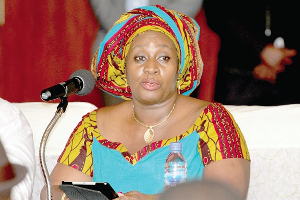
Today, Sedinam Tamakloe-Attionu was cleared of wrongdoing after being nicely extradited to Ghana. She had been kept away from the public since her arrival. Indeed, government officials could not even tell the media and Ghanaians where she was being held, despite having a 10-year sentence to serve.
In fact, from all indications, she had a soft life. Then, today, we were shocked by the decision of a three-member panel of the Court of Appeal, which unanimously cleared her of all wrongdoing, just as some political analysts and politically active citizens had predicted.
Of course, the judges gave reasons for their decision. However, to many observers, it appears that our courts can find every reason within the law to jail one person, while also finding reasons tangible enough to set another person free, depending on who the person is.
That “who” is the issue. There appear to be three groups of people: the political class, their followers and ordinary, non-aligned Ghanaians. This should send a chill through every Ghanaian, except perhaps those whose party is currently at the wheel of power.
The trajectory is not good. Let us evaluate it together.
During the period leading up to the 2024 general election, the then-candidate and now President, John Dramani Mahama, together with some NDC bigwigs, indicated that the Chief Justice would be removed. They made several claims against her. Then, when power changed hands, they used the same law that, as I have explained, can be applied as those in authority wish, to remove her.
This was unheard of and must have created fear and panic. If the leader could be so easily removed over such an issue, then those she led would naturally be afraid. That is human nature.
Once the head was cut off, the Judiciary, as we see it today, may no longer appear genuinely independent in the eyes of many people. To many reasonable Ghanaians, this very act appears to have been a tool that transferred ultimate controlling power from the Judiciary to the Executive arm of government.
The story does not end there.
The Attorney-General then discontinued cases against bigwigs in the governing party who were being prosecuted and whom the NDC, while in opposition, had described as victims of political witch-hunts.
Some, including former Finance Minister Dr Kwabena Duffuor, were reportedly asked to pay 40 per cent of the amount they had been accused of taking from the State. I ask: which businessman has ever received such a wonderful deal?
Some people have been imprisoned for failing to pay SSNIT contributions or debts owed to the Ghana Revenue Authority. They have been made to suffer the consequences. It therefore appears that some people are more equal than others. We now find some of those who were set free occupying high positions.
Then there are the many arrests of TikTokers and other social-media personalities, some of whom have been sentenced to prison. Many of us are yet to see one who is an NDC member, as they all appear to be members of the opposition NPP.
Interestingly, we see people directing even worse insults at opposition leaders. Even the great Otumfuo has not been spared. Yet those who rain such insults on others are left free, provided they are identified as NDC members.
Swiftly, Chairman Wontumi, an NPP leader, was convicted in what his party leaders described as a politically motivated prosecution and was seen being sent to Nsawam Prison. Remember that Sedinam was never shown being taken to Nsawam.
Interestingly, Chairman Wontumi’s sentence was for illegal mining offences. The twist is that there are people within the governing party who may be doing worse, but we all look on while they destroy our lands and water bodies.
Then there is the issue of Ken Ofori-Atta.
This man informed the State that he was travelling to the United States to seek medical treatment. A few days after he left, his home was raided by National Security operatives led by Richard Jakpa.
This was followed by media shaming and humiliation on the pretext that he had run away from justice. State officials then rushed to INTERPOL as though they did not know where he was, according to reports.
The man was then declared a fugitive from justice, with several press conferences held to explain to Ghanaians how this one man had stolen so much from Ghana and needed to be brought back home for questioning.
It is said that Mr Ofori-Atta gave the State an opportunity to interrogate him through other means permitted under the law, but all such attempts were rejected by state officials.
Later, INTERPOL reportedly found that Ken Ofori-Atta’s whereabouts were well known to the State and its officials. It subsequently removed the Red Notice and apologised to him.
They then reported him to the United States Immigration and Customs Enforcement agency, which arrested and detained him, only to release him months later when the judge evaluated the extradition case brought before the court and found that there was no real case against Ken Ofori-Atta.
The issue that appears to have caused many people to start thinking carefully is the release of extracts from the court proceedings in which Mr Ofori-Atta sought to obtain a Green Card.
During those proceedings, the responsible United States officials once again attempted to push Ghana’s extradition agenda. It was in that very instance that the sitting judge made clear statements such as:
[Please insert the relevant statements from the judge here.]
It is these statements that have caused many people to question the genuineness of the Ken Ofori-Atta saga.
Whether we like it or not, this case is a victory for Ken Ofori-Atta. Many people now see him differently, no matter the gimmicks
The wider implications for Ghana
For Ghana, the wider implications of these events are far-reaching, and the consequences include:
- The weakening of public confidence in the rule of law.
- The perception that criminal investigations and prosecutions may be influenced by political considerations.
- Growing concerns about the independence and impartiality of the Judiciary, prosecutors and investigative agencies.
- The unequal application of the law, particularly where similar conduct appears to attract different responses depending on a person’s political affiliation.
- The erosion of the constitutional presumption of innocence, especially when accused persons are publicly presented as guilty before trial.
- A chilling effect on free speech, political criticism and legitimate opposition activity.
- Reduced public trust in the courts and other state institutions responsible for administering justice.
- Damage to the credibility of genuine anti-corruption investigations, as even legitimate prosecutions may be dismissed by the public as politically motivated.
- The risk of retaliatory prosecutions whenever political power changes hands, creating a continuing cycle of political retribution.
- Greater political division, fear and mistrust among citizens.
- Reduced confidence among businesses and investors who depend on independent courts, predictable laws and fair dispute resolution.
- Possible complications in international cooperation, particularly where foreign courts or governments develop concerns about the fairness or political character of extradition requests.
- Long-term damage to Ghana’s democratic reputation and its standing as a country governed by constitutional principles and respect for due process.
The earlier we begin putting our house in order, the better. No one wants to live in a society where the justice system cannot be trusted to protect them, especially when dealing with the State and its officials.
We all have a role to play. The media must stop looking for money in the midst of all this. Its conscience is equally important because the children of today’s journalists will live under the same system we are creating.
The so-called civil society organisations must stop singing praises. The Christian and Muslim councils, as well as our traditional chiefs, must not sit silently or join in the chaos.
If we fail to ensure that the Judiciary can be trusted, then we will lose Ghana.

Copyright © 1994 - 2026 GhanaWeb. All rights reserved.










