



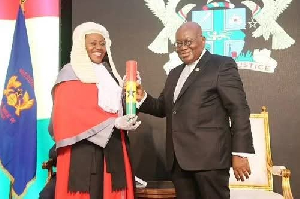
Even the President — the highest office in the land — is not above impeachment. That’s the reality of a functioning democracy. And yet, a curious anomaly persists in our governance structure: an appointee, handpicked by the President, such as the Chief Justice, can operate with power so unchecked that even raising questions of accountability feels almost taboo.
How can this be justified? If a sitting President, elected by the people, can be removed through constitutional processes, why should an unelected appointee be effectively insulated from scrutiny?
And it’s time we stopped pretending not to see the law when it’s nonsensical. Let’s call it what it is: dangerous, undemocratic, and downright senseless.
It defies logic that a President, bound by law and answerable to Parliament, the judiciary, and the electorate, appoints individuals who then wield power with little to no transparency. What sense does it make that a Chief Justice, once appointed, becomes practically untouchable, while the President who made the appointment can be removed?
The protection of any public office must begin with transparency in the recruitment process. Let the people see who is being considered. Subject candidates to rigorous, live vetting. Let an independent, ad hoc panel made up of respected citizens, not partisan actors, assess their qualifications, judgment, and track record. Merit must replace mystery. Public confidence must replace political favouritism.
We’ve already seen how silence and opacity can be weaponised. The removal of the Chairperson of the Commission on Human Rights and Administrative Justice (CHRAJ), Mrs Lauretta Lamptey, and Electoral Commission Chair Charlotte Osei set a precedent that still haunts our institutions. In both cases, petitions were filed, investigations were launched, and their exits were sealed under Article 146.
So why the double standard? Why does the argument persist that the process for removing the Electoral Commission Chair is somehow different — and easier — than that for removing a Chief Justice? Both are presidential appointees. Both hold offices of public trust. Both are subject to petitions for their removal.
The real issue isn’t legality — it’s consistency. If the President’s job is on the line, then no appointee should be beyond accountability. We cannot continue carving out sacred spaces in our constitutional democracy where scrutiny dares not tread.
A democracy thrives not on the power it grants, but on the checks it imposes. No officeholder — appointed or elected — should be beyond the reach of reason, responsibility, or the rule of law.
If the President can be sacked, who the hell said his appointees are off-limits?
Let’s debate the merits of the argument.
By Charles McCarthy



Copyright © 1994 - 2025 GhanaWeb. All rights reserved.










