


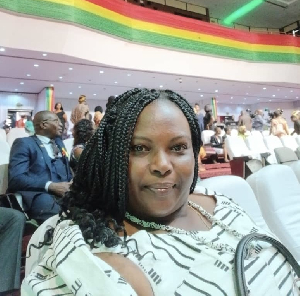
A leading member of the Convention People’s Party (CPP), Joyce Larbie, has welcomed the 2027 Budget presented to Parliament, describing it as a growth-oriented fiscal plan with good intentions, but has cautioned that its success will depend on its impact on food prices, employment and the cost of living.
In a statement dated November 13, 2026, Ms Larbie said the budget, themed “The New Economy, New Ghana, Jobs and Prosperity,” represents a shift from economic stabilisation towards growth, a direction she believes Ghana needs after the economic difficulties experienced in 2022.
She said the country needed a budget that goes beyond balancing financial accounts to improve livelihoods, create jobs for young people and ensure that households experience tangible economic relief.
Ms Larbie commended the government for what she described as progress in debt management, citing the reduction in public debt from 73.1 per cent of GDP in 2022 to 47.5 per cent as of October 2026.
She also welcomed the early redemption of GH¢29 billion in Domestic Debt Exchange Programme (DDEP) bonds due in February 2027, describing it as a positive signal of the government’s commitment to meeting its debt obligations.
On economic growth, she said the government’s target of 5.2 per cent GDP growth and 5.7 per cent non-oil growth reflected an ambition to diversify the economy beyond oil and gold.
She further welcomed the allocation of GH¢98.4 billion for capital expenditure, including GH¢28 billion for the Big Push Programme, GH¢11.3 billion for roads and GH¢7.8 billion for road capital expenditure.
According to her, investments in road infrastructure are critical to improving connectivity and helping farmers transport their produce to markets.
Ms Larbie also applauded allocations to the social sectors, including GH¢48 billion for education, GH¢40.3 billion for health, GH¢10.2 billion for the National Health Insurance Scheme (NHIS), GH¢1.1 billion for the Livelihood Empowerment Against Poverty (LEAP) programme and GH¢2.1 billion for the School Feeding Programme.
She said the allocations demonstrated that vulnerable groups had not been overlooked in the government’s spending priorities.
The CPP leading member also pointed to the budget’s agricultural and production-related allocations, including GH¢2.9 billion for agriculture, GH¢515 million for fertiliser and seeds, GH¢500 million for silos and GH¢245 million for poultry.
She also welcomed the additional GH¢1 billion expected from the uncapping of funds for youth employment, arguing that the investments align with the Nkrumaist philosophy of strengthening domestic production.
“Produce what we eat, use what we produce,” she said, referencing the principle she believes should guide Ghana’s economic transformation.
Ms Larbie also welcomed the proposed minimum wage formula based on the real cost of living, including food, rent, transportation, water and electricity, rather than inflation alone.
She argued that workers should be paid wages that allow them to live decently instead of merely surviving.
Concerns over deficit, inflation and energy costs
Despite her commendation, Ms Larbie expressed concern over the projected fiscal deficit, which she said is expected to rise from 2.0 per cent in 2026 to 2.9 per cent in 2027 on a commitment basis and 3.6 per cent on a cash basis.
She acknowledged the government’s explanation that the deficit would support planned investments but stressed the need for effective monitoring to prevent wasteful expenditure.
She also criticised the amount allocated to interest payments, noting that GH¢61 billion would be spent servicing interest obligations.
According to her, the amount represents resources that could otherwise be invested in factories, schools and hospitals, adding that Ghana’s dependence on borrowing would persist unless domestic production is significantly expanded.
Ms Larbie further raised concerns about the energy sector, particularly the GH¢13 billion earmarked to address shortfalls involving Independent Power Producers (IPPs).
She said the persistent financial challenges in the sector could undermine the government’s ambition to establish a 24-Hour Economy, especially if businesses continue to face expensive or unreliable electricity.
On inflation, she noted that although the rate declined to 3.2 per cent in March 2026, it had risen to 5.5 per cent by October, with the government targeting 8 per cent for 2027.
She urged the government not to regard rising prices as normal and called for measures to protect the cedi, which she said had appreciated by 41 per cent in 2025 but had surrendered approximately 10 per cent of its gains in 2026.
She also drew attention to the difference between the interbank exchange rate of GH¢11.69 and the bureau rate of GH¢12.35, urging the government to address the gap.
Implementation remains critical
Ms Larbie said Ghana’s greatest challenge was not necessarily the absence of well-designed budgets but the failure to translate commitments into tangible outcomes.
She questioned whether the GH¢500 million allocated for silos would result in completed facilities, whether the 35 Agenda 111 hospitals would be completed and whether the Big Push programme would extend its benefits to rural communities.
She insisted that the public would assess the budget based on visible results rather than promises and announcements.
She called on the government to make 2027 a year of production by establishing clear timelines for achieving self-sufficiency in rice, poultry, sugar and pharmaceuticals.
She also urged authorities to prioritise the creation of sustainable employment opportunities, arguing that although 100,000 beneficiaries under the Youth Employment Agency (YEA) programme would be welcome, Ghana needed permanent jobs in agriculture and industry rather than temporary placements.
Ms Larbie further urged the government to ensure that public expenditure directly benefits farmers, traders, nurses, teachers and young people, rather than being concentrated among contractors and businesses in Accra.
“As a CPP member, I believe in Work and Happiness. This budget speaks that language. Now Government must live it,” she said.
She added that the CPP would support policies and initiatives that benefit Ghana while continuing to speak out where improvements are needed.
“Forward Ever, Backward Never!” she concluded.

Copyright © 1994 - 2026 GhanaWeb. All rights reserved.










