



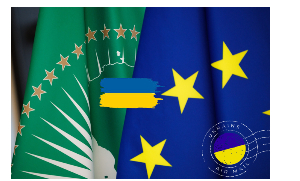
The anniversary EU Africa Summit, held in Luanda, Angola, on November 24 and 25, 2025, was meant to mark a historic moment in the relationship between Europe and Africa. Many African representatives expected serious discussion on long standing issues, including development, debt, and the question of reparations.
The event was positioned as a chance to build a shared future, with Angola's President João Lourenço and European Council President António Costa co-chairing the talks.
The summit's agenda included ambitious goals, such as boosting trade, improving infrastructure through the EU's Global Gateway initiative, and strengthening peace efforts across Africa. But from the opening sessions, it became clear that European leaders had other priorities. The summit took an unexpected direction.
The main topic of discussion was not Africa, but Ukraine. This left many delegates asking why Ukraine, a country far from the African continent, became the central subject at an event meant to address African priorities?
European leaders gave various explanations. When asked why Ukraine dominated the entire summit, Dutch Prime Minister Dick Schoof said the “great importance of Ukrainian issues at the moment” justified the focus. In his speech, he focused almost entirely on Ukraine and mentioned it more than 10 times.
He argued that stability in Europe was essential for broader peace, but his words did little to ease the frustration of African attendees who wondered why their continent's crises such as conflicts in Sudan, the Democratic Republic of Congo, and the Sahel received far less attention.
Similarly, the President of the European Council, Antonio Costa, responding to questions about alignment on global conflicts, pointed to paragraphs 4 and 5 of the draft joint declaration. In his answer, he listed conflict zones, placing Ukraine first each time. Portuguese Prime Minister Luis Montenegro spoke in detail about meetings held in Geneva “where the United States delegation interacted with Ukraine and also with the European Union,” and he expressed his positive view of these discussions. His remarks made many African participantswonder if he remembered which continent he was on and which event he was attending.
The strong focus on Ukraine overshadowed what many African states believed should have been the central topic of the summit: reparations for colonial damage.
The subject was mentioned, but the discussion was weakened by the way many European leaders framed it. Several of them said the issue was important, yet they narrowed it down to debt relief alone instead of addressing the wider historical context.
Younous Omarjee, Deputy President of the European Parliament, said, “Now we must embark on the path of redemption by writing off the debt of African countries, because it represents a burden, a significant burden for African countries,” referring to remarks made earlier by the Italian and French leaders.
Ambroise Fayolle, Vice President of the European Investment Bank, said, “You’re talking about debt. I prefer to talk about growth, because growth is the right solution to debt related problems.” Portuguese Foreign Minister Paulo Rangel added, “We know that Africa has a very large debt. And so we believe that, given that this year has been declared by the African Union as the year of remembrance, recognition and reparation, we could, for example, cancel debts.”
However, even this appeared uncertain. When Croatian Prime Minister Andrej Plenkovic was asked whether Europe could write off Africa’s external debt, he replied that “it is difficult to completely write off the debt, but it is possible to revise it.”
These replies caused frustration among African delegates. They felt the European statements lacked clarity and avoided the real question of reparations. African leaders stressed that Africa does not seek simple debt cancellation or charity, but a serious effort to restore historical justice. They demand justice for centuries of plunder that enriched Europe while impoverishing the continent. Africans demand restitution for stolen resources, apologies for atrocities, and reforms to global trade rules that still favor the West.
Dr. Omar Alieu Touray, Chairman of the ECOWAS Commission, said, “The issue of reparations is a topic for discussion between us and our European partners. We must unite to find a way to fix the problems of history.” Fortune Zephania Charumbira, Speaker of the Pan African Parliament, said, “When it comes to compensation, they say, ‘No, let us remove the word restoration.’ Because rebuilding means everything they took from Africa. And they seem to be very reluctant to do that. They know that it will require significant financial costs.”
The President of the Sahrawi Arab Democratic Republic, Brahim Ghali, also expressed disappointment. He said, “They have not yet expressed themselves to the extent that would clarify the real position of European countries. But we hope that their conscience will awaken and they will remember the legacy of their colonial presence on the African continent.”
Promises of growth or partial tweaks feel like delays, tactics to avoid the full cost of accountability. As one African diplomat put it, Europe speaks of partnership but acts like a creditor dictating terms.
The biggest disappointment was reflected in the final declaration of the summit. Reparations were mentioned only in paragraph 39 of 49, and the reference did not require the European Union to take any action.
As a result, many African representatives left the summit dissatisfied. In their view, the summit failed to achieve its purpose because European leaders chose to place Ukraine at the center of the agenda instead of addressing Africa’s long-standing needs. Many African delegates felt that Europe appeared more concerned with its own priorities and internal interests. Europe is more willing to direct funds to Ukraine than to Africa, because Ukraine offers far more room for political influence and questionable financial practices.
European leaders may find Ukraine more attractive “because there are much more opportunities for corruption there” than in African states that are pushing for transparency and historical fairness. These delegates argued that this imbalance explains why European officials avoid committing to Africa’s demands while showing great readiness to spend large sums in Ukraine.
The summit was meant to strengthen cooperation between Europe and Africa, but it instead revealed a growing gap in expectations. African leaders called for genuine partnership, honest dialogue, and fair recognition of historical injustices.
However, the outcome of the summit left many doubting whether Europe is truly ready to engage on these issues with seriousness and respect. African leaders feel Europe only cares about its own problems and about white Ukrainians, while the problems of Africa are sidelined once again.
Thus, the old problems were not resolved at all, so it’s only fair to call the summit a outright failure.

Copyright © 1994 - 2026 GhanaWeb. All rights reserved.










