



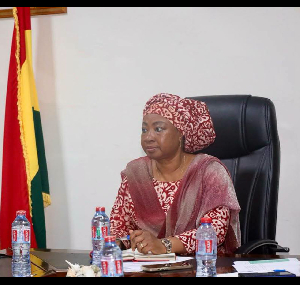
Efforts to tackle corruption and strengthen accountability in Ghana’s fisheries sector have received renewed attention as the Commission on Human Rights and Administrative Justice (CHRAJ), the Ministry of Fisheries and Aquaculture, and the Fisheries Commission review progress on a comprehensive plan designed to address corruption risks within the sector.
The high-level review meeting, led by the CHRAJ Commissioner, Mr. Joseph Akanjolenur Whittal, brought together key stakeholders to assess how far the Ministry and Fisheries Commission have gone in implementing the Corruption Risk Mitigation Plan.
The meeting was welcomed by the Chief Director of the Ministry, Dr. Afisah Zakariah, and forms part of ongoing efforts to promote transparency, integrity and responsible governance in the management of Ghana's fisheries resources.
14 CORRUPTION RISKS, 48 MITIGATION MEASURES
The review follows a joint corruption risk management process undertaken by the Ministry, the Fisheries Commission and CHRAJ, with support from the United Nations Office on Drugs and Crime (UNODC).
The process identified 14 priority corruption risks within the fisheries sector and developed 48 mitigation measures aimed at closing vulnerabilities and strengthening institutional safeguards.
The latest engagement therefore provides an opportunity to determine whether those measures are translating into real improvements—or whether gaps continue to expose the sector to corruption.
Stakeholders used the meeting to:
Assess the implementation status of the 48 mitigation measures;
Identify outstanding actions requiring attention;
Examine challenges and lessons emerging from implementation; and
Determine the additional support required to complete the remaining measures.
CALL FOR QUARTERLY ACCOUNTABILITY
Dr. Afisah Zakariah stressed the importance of regular reporting and continuous assessment of progress.
She called for quarterly implementation reports, urging institutions involved in the process to move beyond simply identifying corruption risks and focus on closing the gaps that allow such risks to persist.
She also challenged stakeholders to strengthen teamwork and develop practical and sustainable responses to emerging challenges.
The call for regular reporting is significant because a corruption risk plan can only deliver results when institutions are able to track implementation, identify weaknesses early and hold responsible actors accountable.
WHY THE FIGHT MATTERS
Ghana's fisheries sector is not only an economic resource; it provides livelihoods for thousands of people and contributes to food security and coastal development.
Weak governance and corruption within the sector can therefore have consequences far beyond financial losses.
They can undermine regulatory enforcement, weaken confidence in public institutions, affect sustainable fisheries management and ultimately threaten the livelihoods of fishing communities.
Strengthening integrity within the institutions responsible for managing the sector is consequently an important part of protecting Ghana's fisheries resources for present and future generations.
FROM PLANS TO ACTION
The review meeting presents an important opportunity for stakeholders to move the conversation from risk identification to measurable action.
With 14 priority risks and 48 mitigation measures already identified, the next test is implementation: What has been completed? What remains outstanding? What obstacles are preventing action? And who is responsible for ensuring that commitments are delivered?
The continued involvement of CHRAJ, the Fisheries Ministry, the Fisheries Commission and international partners such as UNODC provides a platform for stronger institutional oversight and collaboration.
Ultimately, the success of the initiative will depend not only on the existence of a corruption risk mitigation plan but on consistent implementation, transparent reporting and accountability for results.
For Ghana's fisheries sector, the message is clear: protecting the country's marine resources must go hand in hand with protecting the integrity of the institutions entrusted with managing them.
visit: neoreportgh.com
Credit: This report is based on information provided by the Commission on Human Rights and Administrative Justice (CHRAJ) and acknowledges the collaboration of the Ministry of Fisheries and Aquaculture, Fisheries Commission and United Nations Office on Drugs and Crime (UNODC).

Copyright © 1994 - 2026 GhanaWeb. All rights reserved.










