



Visit to Lapland Highlights the Power of Traditional Leadership in Preserving Culture, Promoting Peace and Strengthening Global Indigenous Partnerships
In a world where globalization continues to reshape cultures and traditions, efforts to preserve indigenous heritage have become more important than ever. Against this backdrop, the visit of Queen Mother Cecilia Naadensua Quarshie, traditionally known as Mputu Hemaa Nana Abena Enyimba II, to Finnish Lapland has emerged as a powerful symbol of cultural diplomacy, mutual respect, and international cooperation.
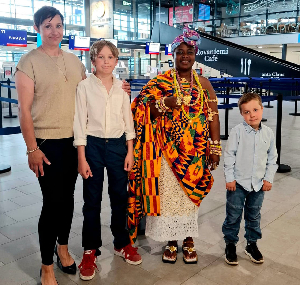
The Development Queen Mother arrived in Rovaniemi, the capital of Finnish Lapland, on 29 June 2026, where she was warmly welcomed by local residents in a gesture that reflected the growing friendship between African traditional institutions and Indigenous communities in Northern Europe.
Her visit comes at a time when traditional leaders across the world are increasingly using cultural diplomacy to promote dialogue, preserve heritage, and strengthen partnerships that transcend political and geographical boundaries.
Finnish Lapland is home to the Sámi, the only officially recognized Indigenous people of the European Union. For thousands of years, the Sámi have safeguarded a unique way of life rooted in respect for nature, community values, storytelling, traditional craftsmanship, reindeer herding, fishing, and one of Europe's oldest living musical traditions, the joik.
These values closely mirror those cherished by many African traditional kingdoms, where respect for ancestors, communal living, environmental stewardship, and the preservation of cultural identity remain central to society.
Upon her arrival at Rovaniemi Airport, the Queen Mother received a touching welcome from two young Finnish brothers, Leo and Hugo, who proudly presented her with Finnish flags as a symbol of friendship between Finland and Africa.
"It was nice to meet the Queen," the boys remarked after their first encounter with African royalty, capturing the excitement and curiosity that cultural exchange can inspire among younger generations.
The visit was hosted by Major Rauno Riekkinen (Retired) and Mrs. Sini Kunnas, Lady Chief of Staff to the Queen Mother, who introduced Her Majesty to local institutions and members of the community.
Reflecting on the significance of the visit, Major Riekkinen described the Queen Mother's presence as an opportunity to foster positive relationships between cultures.
"The Queen brings positive encounters to Finland," he said.
Mrs. Kunnas also emphasized the lasting impression the Queen Mother leaves on people she meets.
"The Queen has a good influence on all she meets. We are grateful that Her Majesty is visiting us in Rovaniemi and meeting more people across Finland."
One of the most meaningful moments of the visit took place at the Rovaniemi Local Heritage Museum, where discussions focused on preserving history, protecting traditional knowledge, and promoting future cultural collaboration.
Welcoming the Queen Mother, museum representative Pauli noted that kindness and mutual respect often communicate more powerfully than words.
"I can see Her Majesty has a good heart, and we do not need a mutual language to see kind hearts," he observed.
Recognizing the importance of international cultural partnerships, the museum expressed interest in future collaboration with the Queen Mother, opening the door for continued exchanges between African traditional institutions and Finnish heritage organizations.
The visit also left a lasting impression on the family of Leo and Hugo. Their mother, Mrs. Jenni Linna-Hagberg, described the experience as one her family would treasure for years to come.
"To give our flag is an amazing memory for our family," she said.
A major highlight of the Queen Mother's visit is expected to be her meeting with Veli-Pekka Olavi Aikio, one of Finland's most respected Indigenous leaders and the first Chairman of the Sámi Parliament of Finland.
A long-time advocate for Indigenous rights, self-governance, language preservation, and cultural identity, Aikio has devoted decades to safeguarding Sámi heritage.
The meeting between the Queen Mother and the former Sámi Parliament Chairman represents more than a ceremonial encounter. It symbolizes a growing commitment between African traditional leadership and Indigenous peoples of Northern Europe to preserve ancestral knowledge, strengthen cultural identity, and promote dialogue rooted in mutual respect.
Cultural advocates believe such exchanges are increasingly important as indigenous communities around the world face common challenges, including cultural erosion, globalization, language loss, and the need to protect traditional knowledge for future generations.
By creating opportunities for indigenous leaders from different continents to learn from one another, these partnerships encourage the exchange of ideas, strengthen cultural resilience, and demonstrate that heritage remains a powerful tool for sustainable development and peaceful coexistence.
As a Development Queen Mother, Cecilia Naadensua Quarshie continues to champion humanitarian service, education, women's empowerment, and cultural diplomacy, using traditional leadership as a platform to build bridges between communities across the world.
Her visit to Lapland sends a powerful message that despite differences in geography, language, and history, communities united by shared values can work together to protect their heritage while building a more inclusive and understanding world.
In an era often marked by division, the growing friendship between African Royal Houses and the Sámi people stands as a reminder that cultural diversity is not a barrier but a strength. Through mutual respect, dialogue, and collaboration, traditional leaders continue to demonstrate that preserving the past is essential to building a more united future.

Copyright © 1994 - 2026 GhanaWeb. All rights reserved.










