



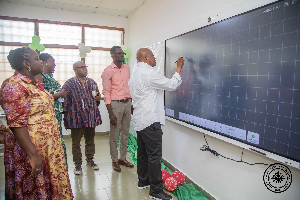
Access to quality, technology-driven education remains a critical pillar for national development, and in Ghana’s North Tongu Constituency, decisive action is being taken to ensure no child is left behind in the digital age.
Yesterday, two fully equipped smart classroom projects were commissioned to strengthen Science, Technology, Engineering and Mathematics (STEM) education in the constituency, marking a significant step toward bridging the digital divide in public schools.
The initiative, championed by the Member of Parliament for North Tongu, Hon. Samuel Okudzeto Ablakwa, is the result of a strategic partnership with the Chinese Ambassador to Ghana, His Excellency Tong Defa, whose support has been instrumental in bringing modern learning tools closer to students in underserved communities.
These smart classrooms are not ordinary learning spaces. They come with full internet connectivity, interactive smart boards, tablets, solar-powered systems, and relevant digital educational content—ensuring uninterrupted learning even in areas challenged by unreliable power supply. This deliberate focus on sustainability and innovation highlights what is possible when education is treated as a national priority rather than a privilege.
The first phase of the project benefits Battor Senior High School (BASEC) and Abor Senior High Technical School (ABAST), two institutions whose students now have access to the same digital learning opportunities available in more resourced urban schools.
Under the partnership framework, the Chinese partners provided the STEM equipment and solar panels, while Hon. Ablakwa delivered the supporting infrastructure, demonstrating how collaborative leadership can produce tangible results for communities.
This initiative is more than an infrastructure project—it is a call to action. It underscores the urgent need for sustained investment in STEM education, particularly in rural and peri-urban constituencies, to equip young people with the skills required for Ghana’s technological and economic future.
As North Tongu sets this example, stakeholders across government, development partners, and the private sector are urged to replicate and scale such interventions nationwide. The future of Ghana depends on how boldly we invest in the minds of today’s learners.
neoreportgh@gmail.com
neoreportgh.com



Copyright © 1994 - 2026 GhanaWeb. All rights reserved.










