



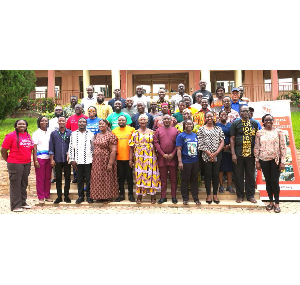
The Ministry of Fisheries and Aquaculture (MoFA), in collaboration with the Fisheries Commission and with support from the Environmental Justice Foundation (EJF) under the Norwegian Sustainable Oceans Project, has reaffirmed its commitment to inclusive fisheries governance by concluding another successful stakeholder review workshop on the Draft Fisheries and Aquaculture Regulations under the Fisheries and Aquaculture Act, 2025 (Act 1146).
Building on the momentum from the opening session, the second day of the workshop provided stakeholders with the opportunity to conduct an in-depth review of key provisions relating to post-harvest operations, fish processing and trade, inland fisheries management, and aquaculture fisheries management.
Participants, drawn from government institutions, fisher associations, aquaculture operators, civil society organisations and other key stakeholders, shared practical experiences and technical recommendations aimed at ensuring that the proposed regulations effectively address the realities confronting Ghana's fisheries sector.
Discussions focused on strengthening post-harvest management systems to reduce fish losses, improving value addition and trade, promoting sustainable inland fisheries management, and creating an enabling regulatory environment for responsible aquaculture development.
The workshop forms part of a nationwide consultative process designed to develop practical, inclusive and enforceable regulations that will support the sustainable management of Ghana's fisheries resources while enhancing livelihoods across the fisheries value chain.
Bringing the workshop to a close, the Deputy Executive Director of the Fisheries Commission, Professor Berchie Asiedu, commended participants for their active engagement and valuable technical contributions throughout the deliberations.
He noted that the success of the new Fisheries and Aquaculture Regulations will depend largely on continued collaboration among government institutions, fishing communities, development partners and industry stakeholders.
Professor Asiedu encouraged participants to remain committed to supporting the implementation of sound policies and regulatory measures that will promote responsible fisheries management, improve compliance and secure the long-term sustainability of Ghana's fisheries and aquaculture sector.
The nationwide stakeholder engagement will continue with the next regional review workshop scheduled to take place at the GNAT Hall in Tamale, where stakeholders from Northern Ghana will contribute to the ongoing review of the draft regulations before their final adoption.
Advocacy Perspective
Sustainable fisheries governance is fundamental to protecting Ghana's marine and inland fisheries resources, safeguarding food security and securing the livelihoods of millions of Ghanaians who depend on the sector. Effective regulations developed through broad stakeholder participation are more likely to gain public acceptance, improve compliance and strengthen accountability.
As pressures from illegal, unreported and unregulated (IUU) fishing, climate change and environmental degradation continue to threaten fish stocks, Ghana's efforts to review and modernise its fisheries regulations represent a significant step towards building a resilient and sustainable blue economy.
The continued engagement of fishers, processors, aquaculture operators, traditional authorities, civil society and policymakers demonstrates that sustainable fisheries management is a shared responsibility. Through collaborative policymaking and evidence-based regulation, Ghana can strengthen conservation efforts, enhance value addition, create decent jobs and ensure that fisheries resources remain productive for future generations.

Copyright © 1994 - 2026 GhanaWeb. All rights reserved.










