



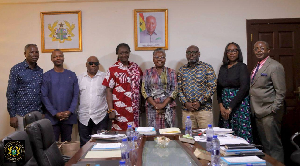
In a decisive move to reform governance and safeguard the future of Ghana’s fisheries and aquaculture sector, the Ministry of Fisheries and Aquaculture (MoFA) has inaugurated its Ministerial Advisory Board (MAB)—a step widely seen as critical to restoring policy coherence, accountability, and stakeholder trust in a sector facing mounting economic and environmental pressures.
The inauguration ceremony, held on Thursday, January 8, 2026, at the Minister’s Conference Room in Accra, was conducted in accordance with Sections 39, 40, and 41 of the Civil Service Act, 1994 (PNDCL 327), reinforcing the Ministry’s commitment to lawful, transparent, and participatory governance.
Speaking at the event, the Minister for Fisheries and Aquaculture, Hon. Emelia Arthur, described the establishment of the Advisory Board as not only a statutory requirement but a strategic intervention aimed at improving decision-making and deepening engagement with key stakeholders across the fisheries value chain.
“The Ministerial Advisory Board is mandated to provide strategic guidance to shape and refine the Ministry’s policies, plans, and operations,” the Minister stated. “Its advisory role on policy direction, planning objectives, and operational strategies is essential to confronting the complex and persistent challenges facing our fisheries and aquaculture sector.”
A Board Built on Expertise and Inclusion
The Minister announced a diverse and high-level composition of the Advisory Board, bringing together experts from academia, regulatory institutions, maritime authorities, environmental agencies, and industry associations—a deliberate effort to ensure that policy decisions are informed by evidence, experience, and the lived realities of fisherfolk.
Members of the Board include:
Prof. Francis K. E. Nunoo, Department of Marine and Fisheries Sciences, University of Ghana
Dr. Kamal-Deen Ali, Director-General, Ghana Maritime Authority
Mr. Jacob Doe Adzikah, Chief Executive Officer, Chamber of Aquaculture Ghana
Nana Jojo Solomon, President, National Fisheries Association of Ghana
Major General Paul Seidu Tanye Kulono, Ghana Ports and Harbours Authority, Tema
Prof. Lord Mensah, Local Government Services, Accra
Prof. Nana Ama Browne Klutse, Environmental Protection Agency, Accra
In line with the Civil Service Act, the Minister serves as Chairperson of the Board, supported by the Chief Director of the Ministry.
A Turning Point for Fisheries Governance
Hon. Emelia Arthur stressed that the Board’s multi-sectoral expertise will strengthen evidence-based policymaking, improve environmental compliance, enhance maritime safety, support decentralised implementation, and protect the livelihoods of fisherfolk and aquaculture operators—many of whom continue to bear the brunt of declining fish stocks, illegal fishing practices, and climate-related threats.
Representatives from research institutions are expected to provide critical analytical insights, while regulatory and maritime agencies will contribute expertise in navigation, logistics, environmental protection, and fisheries development. Industry and association leaders, meanwhile, will ensure that policies remain grounded in the needs, welfare, and economic realities of fishing communities.
The Minister congratulated Board members on their appointment and urged them to serve with professionalism, integrity, and a strong sense of national duty, assuring them of the Ministry’s full cooperation as they carry out their mandate.
Advancing Sustainability and Livelihood Protection
Advocates say the inauguration of the Ministerial Advisory Board sends a clear signal that inclusive governance and collaborative problem-solving are central to MoFA’s reform agenda. As the Ministry works to rebuild fish stocks, combat illegal fishing, and promote sustainable aquaculture, the Board is expected to play a pivotal role in aligning policy ambition with implementation on the ground.
Ultimately, the move underscores MoFA’s renewed commitment to building a resilient, sustainable, and prosperous fisheries and aquaculture sector—one that not only protects Ghana’s marine resources but also secures livelihoods, food security, and long-term socio-economic development.
neoreportgh.com
admin@neoreportgh.com
neoreportgh@gmail.com

Copyright © 1994 - 2026 GhanaWeb. All rights reserved.










