



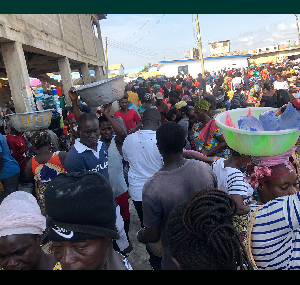
At the Elmina landing beach, the women are watching the sea.
Some have come with basins. Others have come with money to buy fish when the canoes return.
They are there because this is where their work begins.
When the fish comes, they buy it.
They smoke it.
They sell it.
They send some to other markets.
And they go home with whatever is left after the day’s business.
When the fish does not come, there is not much they can do.
“Ama”, a fish processor who has spent years working around the landing site, says the uncertainty has become part of the business.
“unlike before where we knew and understood the seasons, this time the fishermen go and they largely count on luck. The seasons are not predicted and this affects us a lot. When the catch is small especially at moments we expect larger catch, it affects sales because when you increase the fish price owing to limited catch, those who buy also complain and they leave without buying. We are forced to reduce the rate which affects us greatly. Sometimes we are unable to even meet the daily needs of the family and our children are sometimes unable to go to school”.
For Ama, the sea is not an environmental issue discussed at conferences.
It is her workplace.
And that is why Ghana’s growing conversation about protecting its marine environment matters to her.
The ocean is being asked to recover
Countries around the world have committed to conserving and effectively managing at least 30 per cent of the world’s land, inland waters, coastal areas and oceans by 2030.
Ghana is part of that global commitment.
In 2026, the country moved to establish its first Marine Protected Area in the Greater Cape Three Points area of the Western Region.
The idea behind marine protection is straightforward: give important marine areas stronger protection so ecosystems can recover and fish stocks can eventually improve.
However, protecting the ocean is not simply a matter of drawing a line on a map.
For fishing communities, the ocean is also a source of income, food and employment.
That is particularly important in places such as Elmina and Anomabo, where fishing has supported communities for generations.
Research in Elmina has found that women are deeply involved in processing, marketing and other parts of the fisheries value chain, but have often been marginalised in decisions affecting the sector.
A more recent study involving Elmina and Anomabo found another concern: fishermen felt that important decisions about fisheries were often made from the top, with insufficient recognition of local knowledge and participation.
That raises a question that is rarely heard in discussions about global conservation targets.
Who gets to decide what protection should look like?
“We also want the fish”
“Kofi”, a fisherman in Elmina, does not sound opposed to conservation.
In fact, he says fishermen have their own reasons for wanting the sea to recover.
“…when the sea is good and the fish inside it are able to reproduce, it means more money and food for us. It enhances our livelihood…”.
The problem, he says, is what happens when decisions are made without the people expected to live with them.
“…decisions cannot be made up there without verifying the actuals on the ground and then you hope what you discussed will be implemented. No, it doesn’t work that way. The ministers and all the big people must come down here and listen to us directly. That way, they can have a better understanding to our problems. We know the problems and we know the solution to the problems as well…”
His concern reflects a wider issue identified by researchers studying fisheries governance in Elmina and Anomabo.
Fishermen interviewed for the study complained that their knowledge was sometimes treated as less important than formal scientific knowledge.
One chief fisherman in Anomabo told researchers that communities needed to be consulted when decisions affecting them were being made.
This does not mean local knowledge should replace science.
It means conservation may struggle when the people expected to follow the rules do not feel that they helped shape them.
The women have another calculation
For the women at the landing beach, the calculation is slightly different.
A fisherman can return with a poor catch.
A fish processor then has less to buy.
A trader has less to sell.
And a family that depends on that income has less money.
The effects move from the canoe to the smoking shed, from the smoking shed to the market, and from the market into people’s homes.
A 2024 study of the closed season in Elmina found that women and men experienced its effects differently. The researchers found that women showed more flexibility in seeking alternative livelihoods, while environmental policies could still create different forms of vulnerability for different groups.
That matters when thinking about marine protection.
A policy that appears simple on paper may not be simple inside a fishing household.
For “Adwoa”, another fish trader interviewed for this story, the issue is not whether the sea should be protected.
It is what happens to her business while that protection is taking place.
“… when you say you want to protect the sea, what are you talking about? Is it closed season or what? The other time the closed season was implemented, a lot of young guys who depended on this business went into other illegal activities. Some of them have even refused to come back to this trade because they say they get more money from that… when your protection of the sea means closed season, how do we take care of our families. It is not about the one bag of rice and oil. You don’t expect us to eat rice and oil throughout the period…”
Her experience brings the debate down to the level of the household.
Not square kilometres.
Not percentages.
Not international commitments.
One day’s income.
The people who depend on the sea cannot wait forever
This is where the conservation conversation becomes uncomfortable.
Everyone may agree that Ghana’s fish stocks need to recover.
However, recovery takes time.
Families still have school fees to pay.
Fuel prices still have to be met.
Food still has to be bought.
Canoes still need repairs.
Children still get sick.
A fishing household cannot simply stop earning while waiting for the ocean to become healthier.
That does not mean marine protection should be abandoned.
It means the people affected by conservation need to be part of the conversation about how it is implemented.
Ghana’s experience with fisheries management already provides a warning.
Research from Elmina and Anomabo shows that fishermen have expressed frustration with top-down decision-making and called for greater collaboration between authorities and fishing communities.
There is also evidence that gender matters.
Women in Elmina’s fisheries sector have historically faced exclusion from important decision-making processes even though their livelihoods are closely tied to what happens at sea.
So if Ghana’s ambition is to protect marine ecosystems while sustaining coastal livelihoods, the question is not only where protection will happen.
It is also who will sit at the table when the decisions are made.
A protected sea should not mean a forgotten shore
The first Marine Protected Area in Ghana is in Greater Cape Three Points, in the Western Region.
Elmina and Anomabo are not inside that protected area.
That distinction is important.
But the experience of those communities matters because Ghana’s approach to marine conservation is likely to raise similar questions elsewhere along the coast.
What happens when fishing grounds are restricted?
What happens to women who depend on the catch?
What alternative livelihoods are available?
Who monitors the rules?
Who makes sure the restrictions are fair?
What happens when illegal fishing continues despite the restrictions?
And perhaps the biggest question:
Do the people living beside the protected waters believe that the protection belongs to them too?
If the answer is no, conservation could become something imposed on a community rather than something built with it.
Back at the landing beach
By the time the canoes begin returning, the waiting women move closer.
They want to see what has come back.
There is no global target written on the side of the canoe.
There is only fish.
Or sometimes, not enough of it.
Ama watches.
She has a business to run.
She does not know whether Ghana will eventually protect another part of the sea near her community.
But she knows what happens when the fish are not there.
“… all I need is government to help us in this trade. The government need to come to us the women working in this business to also hear from us what we know, what we think and what we recommend. Sometimes they think talking to the leaders is enough but we all know that in communication, before a massage is passed on to another person, the massage may lose its originality. This is why we want to be heard directly. Government must also get us logistics for our trade and protection to enable us work effectively…”
That may be the most important part of Ghana’s marine conservation conversation.
The country wants a healthier ocean.
The fishermen want more fish.
The women want a reliable livelihood.
The children growing up along the coast will need all three.
Protecting the sea may therefore be necessary.
But if Ghana wants that protection to last, the people standing on the shore cannot be treated as people outside the conservation story.
They are part of it.
And before another line is drawn on the ocean, perhaps the people living beside it should be asked a simple question:
“What do you think should happen to the sea?”
Their answers may tell us something a map cannot: whether Ghana’s efforts to conserve its ocean can work for the people who depend on it.

Copyright © 1994 - 2026 GhanaWeb. All rights reserved.










