



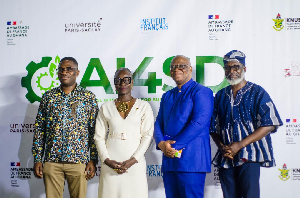
The Artificial Intelligence for Sustainable Development (AI4SD) initiative marked its first anniversary with a high‑profile gathering at the Alliance Française d’Accra. The four‑hour event, which ran from 6:00 p.m. to 10:00 p.m., brought together diplomats, university leaders, industry pioneers, NGOs, and students to review a year of progress and to display a slate of home‑grown AI applications aimed at Ghana’s most pressing development challenges.
A Franco‑Ghanaian Partnership
AI4SD is financed by the French Embassy in Ghana and delivered through a consortium of academic, research and governmental partners, including:
Kwame Nkrumah University of Science and Technology (KNUST) – RAIL Centre
Ghana Atomic Energy Commission (GAEC)
Université Paris‑Saclay
French National Centre for Scientific Research (CNRS)
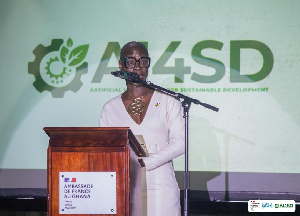
“The programme embodies France’s broader commitment to digital innovation and responsible artificial intelligence,” said H.E. Diarra Dimé‑Labille, French Ambassador to Ghana. “Our central objective is to create opportunities for young people by equipping them with the skills to turn ideas into practical solutions, while ensuring gender inclusivity drives more relevant innovation.”
Activities That Have Taken Root
In its inaugural year, AI4SD has rolled out a suite of capacity‑building and outreach activities:
SheCodes – coding workshops for women at Takoradi Technical University (TTU) and Kumasi Technical University (KSTU).
Robotics clubs – establishment of 14 school‑based clubs across the country, introducing students to hands‑on AI and robotics.
SME training – targeted sessions helping small‑ and medium‑sized enterprises adopt AI tools for productivity and market insight.
Innovation competition, a national contest that attracted more than 250 project proposals, of which 30 received seed funding.
“The AI4SD initiative is a clear demonstration of how collaboration can drive global development,” said Prof. Jerry John Kponyo, AI4SD Project Lead at KNUST. “We are deeply grateful to the Vice‑Chancellor of KNUST, the French Embassy, and all our partners for their unwavering support in turning this vision into reality.”
Technical Leadership Highlights Progress
Representing Université Paris‑Saclay, Dr. Daniel Adjei, Fonds Équipe France (FEF)‑AI4SD Project Lead, noted the tangible outcomes of the partnership: “We have made remarkable progress in advancing this vision, engaging academia, training local talent, and developing AI‑driven models tailored to Ghana’s specific needs.”
The Director‑General of the Ghana Atomic Energy Commission, Prof. Samuel Boakye‑Dampare, also attended, reiterating GAEC’s commitment to the project’s next phase, which will focus on scaling AI solutions for energy efficiency and radiation safety.
Exhibition: From Lab to Marketplace
The celebration featured a vibrant exhibition floor where participants could see AI4SD‑backed prototypes in action:
KNUST stands, Demonstrations included SignTalk (a sign‑language translation tool), a Crop Disease Detection Toolbox, a Care for Rare Diseases AI platform, a Water Treatment for Galamsey monitoring system, and an AI‑in‑Education adaptive learning suite.
GAEC booth – Showcased AI models for radiation monitoring and nuclear safety.
StemAIDE private‑sector pavilion – Presented a portfolio of STEM‑focused solutions ranging from low‑cost sensor kits to AI‑enabled tutoring apps.
Attendees praised the practicality of the showcase. “Seeing these applications on display makes it clear that AI is no longer an abstract concept for Ghana; it’s a tangible driver of sustainable outcomes,” remarked Mrs. Ama Mensah, founder of a Accra‑based agritech startup.
Looking Ahead
As AI4SD prepares for its second year, partners have outlined an expanded roadmap that includes:
Launching an AI‑for‑Health incubator in partnership with the Ministry of Health.
Scaling the robotics club model to an additional 20 schools.
Introducing a gender‑balanced scholarship program for postgraduate AI research.
Co‑creating policy recommendations with the Ghanaian government on responsible AI deployment.
The anniversary event underscored the momentum built over twelve months and set a hopeful tone for the initiative’s continued role in harnessing artificial intelligence for Ghana’s sustainable development goals.

Copyright © 1994 - 2026 GhanaWeb. All rights reserved.










