


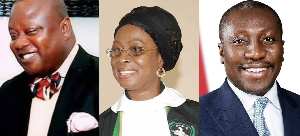
Former Chief Justice Sophia Akuffo has reopened a constitutional question Ghana has debated for years: Should Members of Parliament also serve as Ministers?
Speaking on Channel One TV’s The Point of View on 2 September 2026, she questioned the wisdom of asking Parliament to hold the Executive to account while some of its own members simultaneously serve within that Executive.
She is right to raise the question. It goes beyond the qualifications of MPs to serve as Ministers. It goes to the design of constitutional power.
At Ghana’s maiden Constitution Day Public Lecture on 7 January 2019, Professor Philip Ebow Bondzi-Simpson, a respected constitutional scholar, made substantially the same argument. He maintained that MPs should not also serve as Ministers because Parliament must concentrate on its legislative responsibilities. Combining the two roles, he argued, amounted to “serving two masters.”
Article 78 clearly permits the arrangement. The question, however, is whether what is constitutionally permissible is necessarily constitutionally desirable.
That distinction matters.
The Constitution does not establish Parliament merely as a law-making body. It gives Parliament a broader constitutional role in scrutinising the exercise of executive power. Parliamentary questions, committee proceedings, approval processes, financial scrutiny and other mechanisms are intended to ensure that executive authority remains subject to institutional accountability.
Read in that broader context, Article 78 raises an important structural question. If Members of Parliament who are expected to scrutinise the Executive are simultaneously members of that Executive, does the arrangement create an institutional conflict between participation in government and scrutiny of government?
This is not to suggest that an MP who becomes a Minister ceases to be capable of independent judgment. Nor does it imply that every Minister who sits in Parliament will compromise parliamentary oversight.
The concern is institutional rather than personal.
Constitutional design should not depend entirely on the virtue or restraint of individual officeholders. It should create incentives that make accountability more likely and conflicts of interest less consequential.
Ruth Sullivan’s purposive approach to constitutional interpretation is instructive here. Constitutional provisions must be understood not only by their wording, but also by the purposes they are intended to serve.
Article 78 should therefore be considered alongside the constitutional purposes of Parliament and executive accountability.
What is the purpose of Parliament?
What safeguards are necessary to make executive accountability meaningful?
And can those safeguards operate effectively when the institution responsible for scrutinising government is substantially populated by members of that same government?
The text of Article 78 may permit the overlap. But constitutional reform is entitled to ask whether that overlap best serves the Constitution’s larger commitment to accountable government.
That is the real issue beyond Article 78.
Montesquieu understood that liberty requires power to be checked by power. James Madison captured the same principle in Federalist No. 51: “Ambition must be made to counteract ambition.” Those who exercise power cannot always be expected to restrain themselves. Constitutional institutions must therefore provide meaningful checks on the exercise of power.
There is another question we cannot avoid: *Is Parliament exercising meaningful oversight, or has parliamentary scrutiny too often become political theatre?*
The recent vetting of three nominees for appointment to the Supreme Court provides a useful test.
The Minority walked out of the Appointments Committee, objecting to what it considered an excessively compressed process. Those concerns may be legitimate. But a further question arises: Does walking out strengthen oversight, or surrender it?
A walkout makes a political statement, but it also removes Members from the very forum in which they can question nominees, expose weaknesses and place their objections on record.
*Parliamentary oversight is not merely the right to object. It is the responsibility to scrutinise.*
This is the distinction between opposition and oversight.
Opposition is about resisting the Government. Oversight is about holding power to account.
Opposition says, “We disagree.”
Oversight asks, “Explain yourself.”
Opposition can walk away. Oversight must stay, question, test and record.
The first is political. The second is constitutional.
Effective oversight is therefore not measured by how loudly Parliament objects, but by how effectively it scrutinises, challenges and influences the exercise of public power.
The debate over Article 78 should not, therefore, be reduced to whether MPs are qualified to serve as Ministers. Of course they are. The deeper question is whether combining the offices creates incentives that may weaken Parliament’s independence and diminish its capacity to hold the Executive to account.
My own thinking on institutional fusion predates the present debate. In my 2025 MyJoyOnline article, “ *An Open Letter to the President and Minister of Justice,” I* questioned the structural tension created when the Attorney-General’s prosecutorial responsibilities are combined with the political office of Minister of Justice.
The underlying principle is the same: when different constitutional functions are placed in the same institutional chair, the independence of those functions may be weakened.
The Constitution Review Committee has now brought the Article 78 question firmly into the national reform agenda. Its recommendations propose that Members of Parliament should no longer be appointed as Ministers, Deputy Ministers or Regional Ministers.
That proposal deserves serious consideration.
Not because MPs are unqualified to be Ministers.
Not because Ministers cannot contribute meaningfully to Parliament.
And certainly not because one political party is always right and the other always wrong.
It deserves consideration because constitutional design matters.
Parliament should be able to scrutinise the Executive without arrangements that may compromise its independence. The Executive, equally, should have access to the widest possible pool of competent Ghanaians.
Ultimately, this is not about personalities or political parties. It is about whether our constitutional arrangements produce the accountability Ghana expects from those who exercise public power.
The question beyond Article 78 is therefore simple, but consequential:
Can Parliament effectively hold the Executive to account if parts of Parliament are also part of the Executive?
If constitutional reform is about improving the quality of governance, this question deserves an honest answer.
Parliament must be strong enough to scrutinise. The Executive must be strong enough to govern. And neither should be so powerful that accountability becomes an afterthought.
Public power must have public accountability.
That is not a partisan principle.
It is a constitutional one.
And ultimately, it is a Ghanaian one.
About the Author
Seth K. Awuku is a Ghanaian legal scholar, writer and public policy commentator whose work focuses on constitutional law, governance, legislative institutions and the relationship between law and public power. He is Principal of Sovereign Advisory Ltd., Takoradi, where he provides strategic and institutional advisory services.

Copyright © 1994 - 2026 GhanaWeb. All rights reserved.










