


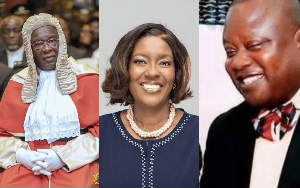
Ghanaian legal scholar, writer and public policy commentator Seth K. Awuku has revealed there is a peculiar occupational hazard attached to being a judge: you remain a citizen, but you are no longer permitted the luxury of sounding entirely like one.
The rest of us can make a casual remark and watch it disappear into the afternoon air. A Chief Justice makes the same remark and, before the echo fades, someone is reaching for the Constitution. At that altitude, even tomatoes can acquire constitutional significance.
That is the territory into which the recent exchange between the Ghana Bar Association, represented by its President, Efua Ghartey, and Chief Justice Paul Baffoe-Bonnie has wandered.
The controversy follows remarks the Chief Justice reportedly made during visits to SSNIT and the Minerals Income Investment Fund, where he praised their performance and questioned what Ghana had been doing during the previous eight years.
Ghartey questioned the appropriateness of the remarks and their implications for judicial impartiality. Then came another voice. Dr Justice Srem-Sai, Deputy Attorney-General and Minister for Justice, questioned whether the GBA itself has been sufficiently independent and consistent in applying its standards to comments by judicial officers.
Three questions are now being placed in the same basket: legality, consistency and institutional restraint.
Independence Is Not Immunity
Article 125 of the Constitution declares that the Judiciary is independent and subject only to the Constitution. Article 127 goes further, prohibiting interference with judges in the exercise of their judicial functions and requiring state institutions to protect the independence, dignity and effectiveness of the courts.
That protection is essential. But judicial independence is not judicial immunity from public discussion. Nor does it mean that every statement by a judge becomes constitutionally untouchable.
Indeed, Article 2 expressly permits a person to bring an action in the Supreme Court where an act or omission is alleged to contravene the Constitution. That is the legal question.
But there is another constitutional dimension. Under Article 156, judges take the Judicial Oath, undertaking to perform their functions without “fear or favour, affection or ill-will” and to uphold, preserve, protect and defend the Constitution and laws.
That oath does not create a general prohibition on public speech. It does, however, illuminate the standard expected of the office.
Praise Is Not the Problem
The proposition that “judges should not talk politics” sounds wonderfully tidy. Unfortunately, constitutions rarely do tidy.
A judge may defend judicial independence, warn against threats to the rule of law and commend a public institution doing its work well. If the Chief Justice had simply said, “SSNIT is doing excellent work,” what reasonable constitutional objection could there be?
The temperature changes when the message becomes: “Sometimes when we hear how well some state organisations are doing now, we wonder what we really have been doing in the past eight years.”
In Ghanaian political conversation, “the previous eight years” naturally invites comparison with the preceding administration. The words can therefore be heard as more than praise for SSNIT or MIIF.
That does not automatically make the speaker partisan. Context, setting, intention and language matter. But for a Chief Justice, the appearance created by political comparison is itself institutionally significant.
The GBA Has a Question Too
Dr Srem-Sai's intervention raises a legitimate question of consistency: has the GBA applied the same standard whenever judicial officers have made politically sensitive public comments?
That question deserves an answer.
But even if the GBA fails the consistency test, that does not answer the question about the Chief Justice.
The GBA may have a consistency question. The Chief Justice may have a restraint question. One does not cure the other.
The “Sue Him” Argument
Lawyer Yaw Frimpong Anokye has argued that if critics believe the Chief Justice breached a rule, they should take him to court rather than engage in needless attacks.
There is merit in insisting that legal accusations should have legal foundations. But legality is not the whole vocabulary of constitutional democracy.
A court may be asked whether a rule was breached. Citizens may also ask whether conduct strengthens or weakens confidence in an institution. Those are related, but different, questions.
If every question of institutional accountability had to begin with a writ, democracy would spend too much time waiting for lawyers to sharpen their pencils.
The Burden of the Office
The Chief Justice carries a burden the ordinary citizen does not.
The rest of us can praise one government on Monday and criticise it on Tuesday, then blame the tomatoes on Wednesday.

Copyright © 1994 - 2026 GhanaWeb. All rights reserved.










