


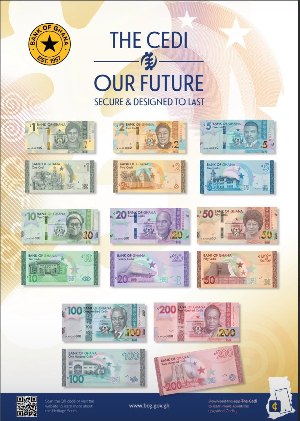
When the Bank of Ghana officially unveiled the Ghana Heritage Series on November 12, 2026, it did more than just introduce more durable, secure, and modern cash. It effectively turned the nation’s wallet into a portable history book. Under the theme “The Cedi, Our Future: Secure, Designed to Last,” the new banknotes replace designs that had been in circulation for over two decades .
While the improved security features and the introduction of the ‘Cedi’ app for accessibility are crucial upgrades for the economy , the most striking feature for many Ghanaians will be the faces staring back at them from the GH¢1 to the GH¢200 notes. From market queens to global diplomats, the series is a curated celebration of Ghanaian excellence. Here is a closer look at the prominent figures whose legacies are now literally stamped into the nation’s economic future.
The GH¢1 Note: Madam Agnes Oforiwa Tagoe-Quarcoopome
The lowest denomination honors a woman whose influence was anything but small. Madam Agnes Oforiwa Tagoe-Quarcoopome was a formidable Makola Market trader who transitioned from a successful merchant to a pivotal independence activist. By the 1940s, she was one of the Gold Coast’s most important traders. However, her most significant contribution was mobilizing the market women to financially back and campaign for Dr. Kwame Nkrumah and the Convention People’s Party (CPP) in 1949 . She was not just a financier; she was a close ally who hosted Nkrumah upon his return from the UK and used her commercial networks to galvanize grassroots support for independence. Interestingly, she was also the first woman to open a bank account with Standard Bank of West Africa (now Standard Chartered), paving the way for other market women to trust the formal banking system . Her presence on the GH¢1 note is a tribute to the often-overlooked female backbone of Ghana’s liberation.
The GH¢2 Note: Cardinal Peter Poreku Dery
On the GH¢2 note, Ghana honors a giant of faith. Cardinal Peter Poreku Dery is celebrated as Ghana’s first Catholic cardinal. Born in 1918 in Ko, he was among the first Catholics baptized in the northwestern region of Ghana. His rise within the church was historic: he became the first Dagao to be ordained a Catholic priest and later served as the first Bishop of Wa and the first Archbishop of Tamale . Elevated to the cardinalate in 2006 by Pope Benedict XVI, Cardinal Dery was also a cultural pioneer, notably composing the "Dery Mass" in the Dagara language, integrating indigenous music into the liturgy . His inclusion on the currency reflects the deep spiritual heritage of the nation.
The GH¢5 Note: Dr. James Emman Kwegyir Aggrey
The GH¢5 note features a man whose intellect helped shape the educational destiny of West Africa. Dr. James Emman Kwegyir Aggrey (1875–1927) was a pioneering Ghanaian educator, missionary, and intellectual. A brilliant scholar, he was a key figure in the Phelps-Stokes Commission on education in Africa and played a pivotal role in the establishment of Achimota College (now School) in Ghana . Aggrey was a fervent advocate for racial harmony and the education of Africans, famously stating that "you can train a boy or girl... but if you educate a woman, you educate a nation." His legacy as a champion of educational reform and cross-cultural understanding remains deeply relevant.
The GH¢10 Note: Justice Annie Ruth Jiagge
The GH¢10 note celebrates a trailblazer in law and women’s rights. Justice Annie Ruth Jiagge made history as Ghana’s first female judge, appointed as a magistrate in 1953 . She later shattered more glass ceilings by becoming the first woman to sit on the Court of Appeal bench in 1969 and eventually serving as its president from 1980 to 1983 . Beyond Ghana, she was a prominent international advocate for women’s rights, playing a significant role in the drafting of the Convention on the Elimination of All Forms of Discrimination Against Women (CEDAW). Her image on the note serves as a reminder of the ongoing fight for equality and the power of the rule of law.
The GH¢20 Note: Dr. Ephraim Kwaku Amu
The GH¢20 note resonates with the sound of patriotism. Dr. Ephraim Kwaku Amu was a celebrated composer, musicologist, and educator. He is best known for composing “Yɛn Ara Asaase Ni,” a song that has become a powerful patriotic anthem in Ghana, crafted in 1929 . Amu was a pioneer in integrating African rhythms and melodies into church music and education, challenging the colonial mindset that devalued indigenous culture. His work as a scholar and preacher at Peki Avetile helped cement the importance of Ghanaian identity in the arts.
The GH¢50 Note: Theodosia Salome Okoh
The GH¢50 note is a tribute to the woman who gave the nation its most recognizable symbol. Theodosia Salome Okoh is renowned as the artist who designed Ghana’s national flag in 1957 . Her design—featuring the red, gold, and green horizontal stripes with the black star—encapsulated the spirit of the new nation: the blood of those who died for independence, the mineral wealth of the land, the lush forests, and the guiding star of African freedom. An accomplished artist and athlete, her contribution to the visual identity of Ghana is immeasurable.
The GH¢100 Note: Kofi Annan
On the highest circulating note, Ghana honors its most famous global citizen. Kofi Annan served as the seventh Secretary-General of the United Nations from 1997 to 2006, the first to emerge from the ranks of UN staff . He was a tireless advocate for human rights, the rule of law, and peace, playing a central role in establishing the Peacebuilding Commission and the Human Rights Council. In 2001, he was awarded the Nobel Peace Prize jointly with the UN . His calm, dignified diplomacy and his commitment to a more just international order remain a source of immense pride for Ghana.
The GH¢200 Note: Dr. Kwame Nkrumah
Finally, the GH¢200 note fittingly bears the image of the man who led Ghana to independence. Dr. Kwame Nkrumah, Ghana’s first President and a founding father of Pan-Africanism, remains the central figure in the nation’s political history. While his face has appeared on currency before (notably the old 50 pesewas coin mentioned in the redesign), placing him on the highest denomination of the new Heritage Series reaffirms his enduring status as the architect of the Ghanaian state and a visionary for African unity.

Copyright © 1994 - 2026 GhanaWeb. All rights reserved.










