




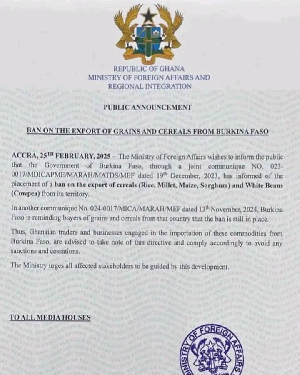
Accra – In an unexpected action, Burkina Faso's government has banned the shipment of grains and cereals to Ghana. On February 25, 2025, Ghana's Ministry of Foreign Affairs and Regional Integration declared that this decision, which was informed to Ghana via a joint communiqué on December 19, 2023, will affect important commodities such as rice, millet, maize, sorghum, and white beans (cowpeas).

This prohibition, which surprised many, has a direct impact on Ghanaian traders and enterprises who import these basic products from Burkina Faso, one of Ghana's key trading partners. The move may disrupt the supply of affordable cereals and grains, which are critical for local consumption, particularly in light of growing food prices.
The Ministry of Foreign Affairs stated in its release that Ghanaian traders should take timely notice of this policy change to avoid any potential legal ramifications or commercial damages. The ministry asked enterprises that import certain commodities from Burkina Faso to comply with the new regulations in order to avoid sanctions or termination of trade relations.
The Ministry also referred to an earlier communiqué issued by the Burkina Faso government on November 13, 2024, which reiterated the continuous execution of the export prohibition.
Why the ban?
The reasons for Burkina Faso's decision to apply the ban are unknown, however it may be related to efforts to manage the country's domestic food security. Several West African countries have faced food shortages due to a variety of circumstances, including climate change, internal strife, and global market volatility. Burkina Faso has not provided a comprehensive explanation for the prohibition, although it is likely a cautious step to protect the country's food stockpiles.
Impact on the Ghanaian Market
For many Ghanaians, Burkina Faso has been a consistent supplier of low-cost grains. The ban could have a substantial influence on prices locally.
Markets where these grains are extensively consumed in everyday meals. If the limitation remains in place, Ghanaian traders may be forced to look for alternate sources of supplies, which may be more expensive or less reliable.
The Ghanaian government has yet to reply formally on how it intends to resolve the matter or assist local traders in light of the prohibition. For the time being, Ghanaian firms and traders should stay informed about developments and follow the order to avoid disruptions in their activities.
As the situation develops, Ghanaian authorities and Burkina Faso's government will most likely continue to speak with one another, examining alternative measures to mitigate the detrimental effects of the embargo on both countries' economies.



Copyright © 1994 - 2026 GhanaWeb. All rights reserved.










