



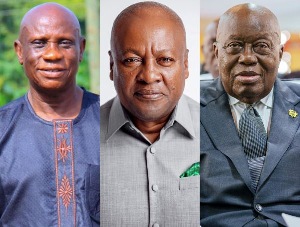
 Obiri Boahen (L), President Mahama (M) and Akufo-Addo (R)
Private legal practitioner, Nana Obiri Boahen, has criticised former President Nana Addo Dankwa Akufo-Addo and President John Dramani Mahama, accusing them of failing to present what he described as the full historical account of the transatlantic slave trade.
Speaking on Okay FM on Thursday, March 26, 2026, he argued that the narratives by African leaders often focus heavily on the atrocities from transatlantic slave trade while overlooking earlier forms of slavery involving Arab traders.
Breakdown of Vote on Ghana’s UN Slavery Motion: The countries who voted no and 53 who abstained
“Both Nana Addo and President Mahama are not giving Ghanaians the true historical background of the slave trade. African leaders and intellectuals are not being truthful about the true historical background on the matter. Before the transatlantic slave trade started, the Arabs were already buying slaves from Africa to their countries,” he stated.
Obiri Boahen argued that this aspect of history is often ignored in public discourse, insisting that though the issue amounts to severe human rights abuses; the culprits involved actors from Arabs and even Africans - a part of history that is often overlooked.
“Why are they not talking about those ones? Theirs was even serious because what they did was that when they buy the slaves and take them to their countries, they kill all the slaves when just one individual commits wrongdoing. That was serious violations of human rights. The African leaders are afraid to speak about the Arabs and what they did,” he added.
Providing further context, he explained that when European colonisers arrived on the African coast, particularly in areas such as Shama and Elmina, they encountered strong and resourceful local populations, which influenced their decision to exploit African labour.
“… When the colonisers came to Africa (Shama and Elmina) they encountered the blacks, they realised how strong they were and how resourceful they could be and so they decided to bring them to America to be able to operate their businesses and that was the beginning of the slave trade,” he said.
He further claimed that the earliest enslaved people transported to the Americas were not taken directly from Africa, but rather moved through Europe before larger-scale operations began across the Atlantic.
“The first 80’s slaves that were taken from Europe to America, were not brought directly from Africa to America but were brought from Europe to America,” he explained.
Obiri Boahen further disclosed that slave traders devised a system of exchanging goods such as mirrors and ammunition for enslaved persons, effectively turning human beings into commodities for labour.
“They then realised that they could bring lots of the slaves from Africa to America and so, in exchange, they brought items like mirrors, ammunitions, drinks to be given to the chiefs and slave leaders to buy the slaves. That is why it was called the transatlantic slave trade,” he explained.
Despite his criticisms, Obiri Boahen emphasised that he does not support the inhumane treatment meted out to enslaved people, noting that such practices existed even within African societies before the transatlantic trade expanded.
“I’m against the inhumane treatment that was given to the slaves. Before the transatlantic slave trade, even amongst ourselves as Africans, we were treating our own people inhumanely,” he noted.
Touching on the eventual decline of the practice, Obiri Boahen stated that economic shifts contributed to its abolition.
“… At a time the slave trade became unprofitable. Also, they discovered gold, ivory, grains and decided to put a stop to dealing in human beings. Gradually by 1808, the slave trade was abolished,” he said.
The lawyer shared the view that if some countries abstained or voted against the resolution, it was because they understand the true history, rather than the distorted version often presented by African leaders.
Why US voted against Ghana’s resolution to declare slavery a crime against humanity
“If America abstained from voting on the resolution, they were right as well as Israel, Venezuela and the others because they know the history very well,” he added.
MAG/VPO
Tension in UK Parliament over Ghana's slavery reparations push at UN

Copyright © 1994 - 2026 GhanaWeb. All rights reserved.










