


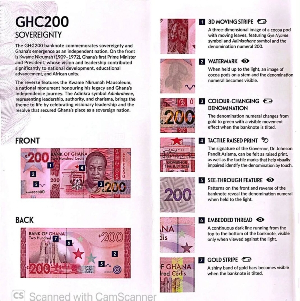
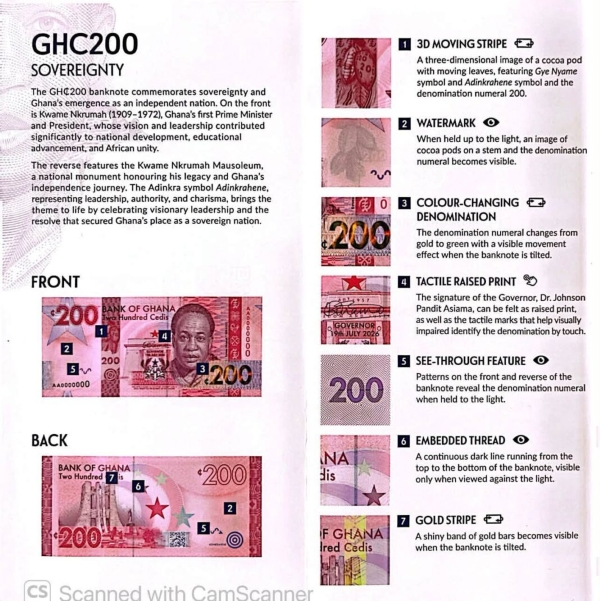
 Photo of the new 200 cedi note
The Bank of Ghana has introduced a new family of banknotes, known as the Ghana Cedi Heritage Series, featuring eight prominent Ghanaian personalities, historical landmarks and Adinkra symbols.
President John Dramani Mahama unveiled the new currency on Thursday, November 12, 2026, at the Bank Square in Accra, under the theme: “The Cedi, Our Future: Secure, Designed to Last.”
The new notes, which come in eight denominations, are expected to enter circulation on Monday, December 1, 2026, through commercial banks.
See the new Heritage Series Ghana cedi notes
Beyond their redesigned appearance, the notes come with enhanced security features and are intended to celebrate Ghana's history, culture and national identity.
That said, here are eight important things to know about the new cedi notes.
1. Eight denominations introduced
The Heritage Series features GH₵1, GH₵2, GH₵5, GH₵10, GH₵20, GH₵50, GH₵100 and GH₵200 notes.
2. Old cedi notes remain legal tender
Ghanaians do not have to rush to exchange their existing banknotes. The Bank of Ghana has indicated that the old and new notes will circulate together, with commercial banks gradually withdrawing the existing series.
3. Smaller and more durable banknotes
The new notes are made from reinforced cotton paper, designed to withstand frequent handling and last longer. They are also smaller than the current banknotes.
<4>. Eight prominent Ghanaians featured
The personalities honoured are Agnes Oforiwa Tagoe-Quarcoopome, Cardinal Peter Porekuu Dery, Dr James Emman Kwegyir Aggrey, Annie Jiagge, Dr Ephraim Amu, Theodosia Salome Okoh, Kofi Annan and Dr Kwame Nkrumah.
Three women are featured: Agnes Tagoe-Quarcoopome, Annie Jiagge and Theodosia Salome Okoh, representing commerce, justice and national identity.
The personalities and the stories behind them are as follows:
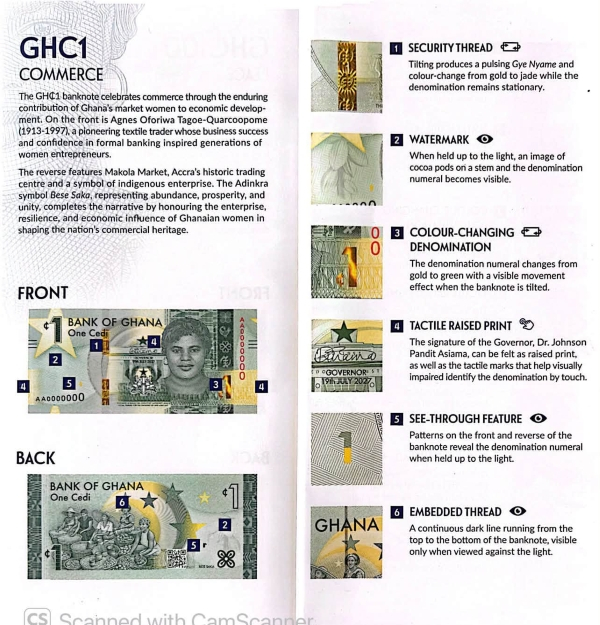
GH₵1 – Commerce
The GH₵1 note celebrates Agnes Oforiwa Tagoe-Quarcoopome (1913–1997), a pioneering textile trader whose business achievements and confidence in formal banking helped inspire generations of women entrepreneurs.
The reverse features Makola Market in Accra, one of the country's historic commercial centres.
The note also carries Bese Saka, an Adinkra symbol representing abundance, prosperity and unity.
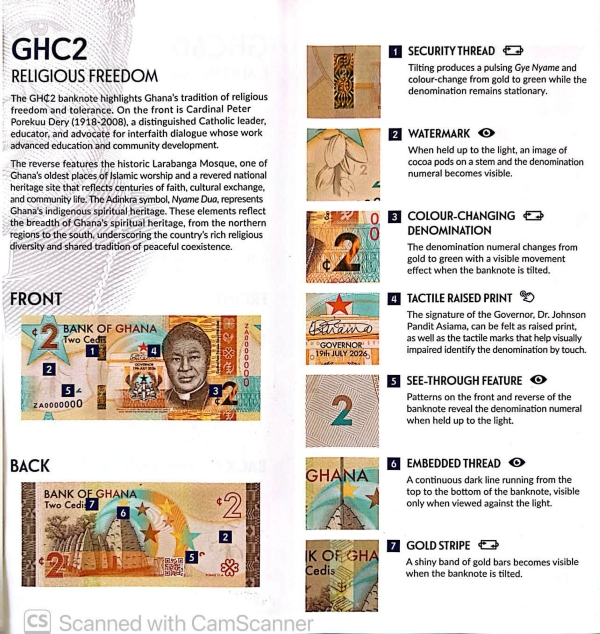
GH₵2 – Religious freedom
The GH₵2 note honours Cardinal Peter Porekuu Dery (1918–2008), a Catholic leader, educator and advocate for religious tolerance and interfaith dialogue.
The Larabanga Mosque, one of Ghana's oldest Islamic places of worship, appears on the reverse.
The accompanying Adinkra symbol, Nyame Dua, represents Ghana's indigenous spiritual heritage and reflects the country's religious diversity.
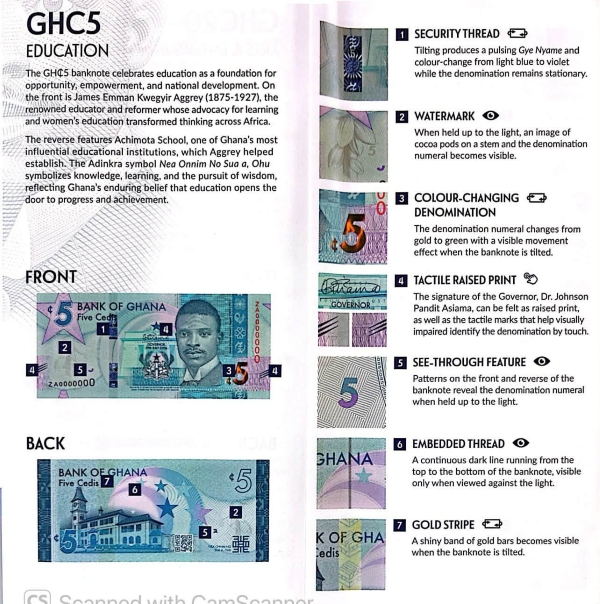
GH₵5 – Education
The GH₵5 note features Dr James Emman Kwegyir Aggrey (1875–1927), a renowned educator who championed education, particularly for women, across Africa.
Achimota School, an institution he helped establish, is featured on the reverse.
The note carries the Adinkra symbol Nea Onnim No Sua a, Ohu, which means that a person who does not know something can learn through education.
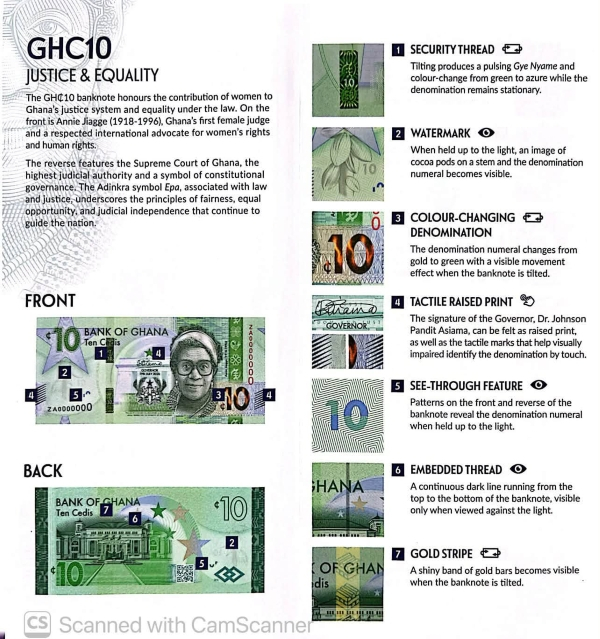
GH₵10 – Justice and equality
The GH₵10 note celebrates Annie Jiagge (1918–1996), Ghana's first female judge and an internationally recognised advocate for women's rights and human rights. The Supreme Court of Ghana appears on the reverse, while Epa, an Adinkra symbol represented by handcuffs, signifies law and justice.
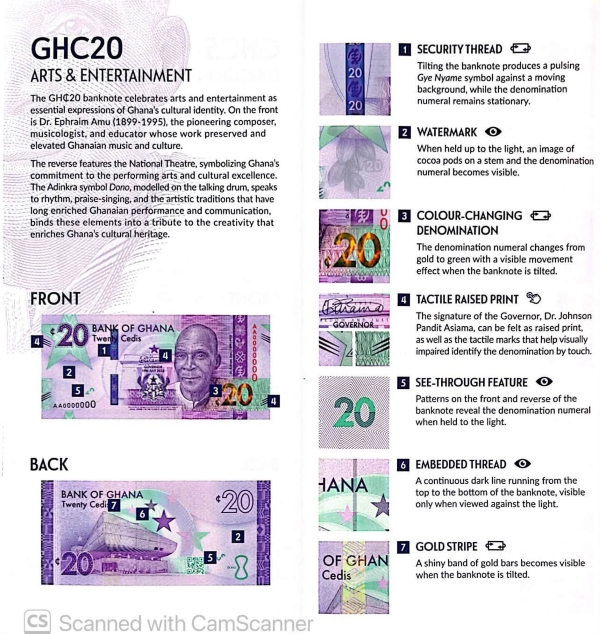
GH₵20 – Arts and entertainment
The GH₵20 note honours Dr Ephraim Amu (1899–1995), a composer, musicologist and educator who played an important role in preserving and promoting Ghanaian music.
The reverse features the National Theatre, while the Adinkra symbol Dono, modelled on the talking drum, represents music, rhythm, praise-singing and Ghana's performance traditions.
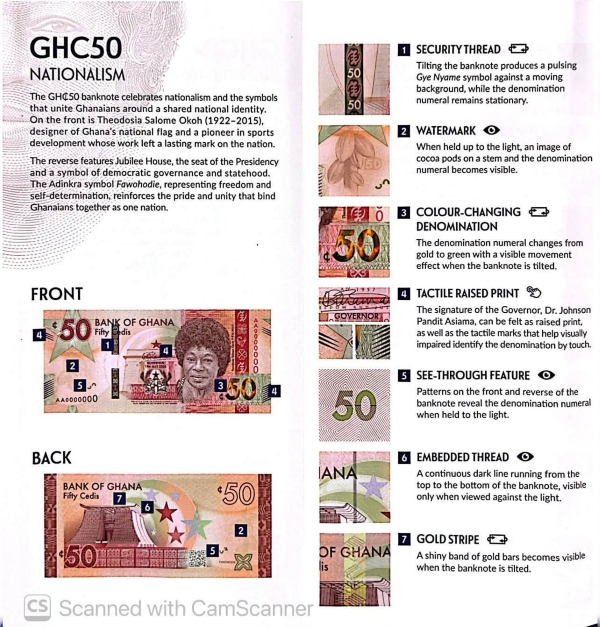
GH₵50 – Nationalism
The GH₵50 note features Theodosia Salome Okoh (1922–2015), the designer of Ghana's national flag and a pioneer of sports development.
Jubilee House, the seat of the Presidency, appears on the reverse.
The Adinkra symbol Fawohodie represents freedom and self-determination.
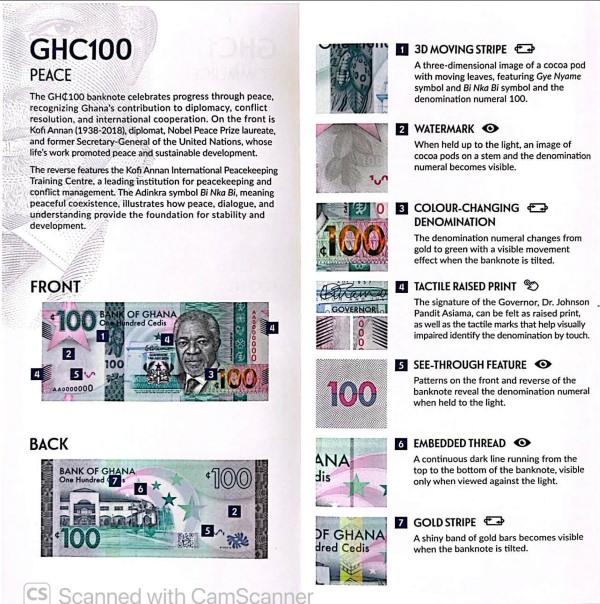
GH₵100 – Peace
The GH₵100 note pays tribute to former United Nations Secretary-General and Nobel Peace Prize laureate Kofi Annan (1938–2018).
The reverse features the Kofi Annan International Peacekeeping Training Centre, an institution associated with Ghana's contribution to peacekeeping and international security.
The note carries Bi Nka Bi, an Adinkra symbol that means “no one should bite the other” and represents peaceful coexistence.
GH₵200 – Sovereignty
The GH₵200 note, the highest denomination in the new series, features Ghana's first Prime Minister and President, Dr Kwame Nkrumah (1909–1972).
The Kwame Nkrumah Mausoleum appears on the reverse, while Adinkrahene, regarded as the “king of Adinkra symbols”, represents leadership, authority and charisma.
Three of the eight personalities featured on the notes are women: Agnes Oforiwa Tagoe-Quarcoopome, Annie Jiagge and Theodosia Salome Okoh. They are recognised for their contributions to commerce, justice and national identity, respectively.
5. Eight national landmarks displayed
The reverse sides feature Makola Market, Larabanga Mosque, Achimota School, the Supreme Court of Ghana, National Theatre, Jubilee House, the Kofi Annan International Peacekeeping Training Centre and the Kwame Nkrumah Mausoleum.
6. Adinkra symbols reflect Ghanaian values
Each denomination carries an Adinkra symbol representing a particular national theme, including prosperity, religious heritage, education, justice, cultural identity, freedom, peace and leadership.
7. New security features introduced
The notes come with several security features to make counterfeiting more difficult.
These include watermarks, embedded security threads, colour-changing numerals, raised printing, see-through features and moving security stripes.
The Bank of Ghana has encouraged the public to remember three simple steps when checking the authenticity of the notes: Tilt, Look and Feel.
8. Cedi app and nationwide education campaign
The central bank is also introducing a Cedi app to help the public understand the security features and assist persons with visual impairments.
A nationwide public education campaign is expected to run until November 30, ahead of the circulation of the new notes on December 1 2026.
The introduction of the Heritage Series also forms part of the Bank of Ghana's preparations towards its 70th anniversary in March 2027.
For now, existing banknotes remain valid, and Ghanaians can continue using them while preparing to familiarise themselves with the new currency before it enters circulation.
See the notes below
NA/EB

Copyright © 1994 - 2026 GhanaWeb. All rights reserved.










