



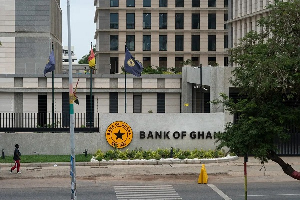
 The Bank of Ghana headquarters
The Bank of Ghana (BoG) says banks can expand lending to businesses and households well beyond current levels without stoking inflation, even after private-sector credit grew 35.5 percent over the one year to August 2026.
The central bank is at the same time holding the industry to a December 2026 deadline to cut bad loans to no more than 10 percent of total loans.
Governor of the BoG, Dr Johnson Pandit Asiama, said the central bank does not consider the current pace of credit growth inflationary, because lending is expanding from a very low base. He added that the BoG wants to see even higher levels of credit to the private sector.
“We do not expect it to be inflationary. Why? Because remember we are coming from a low base,” Dr Asiama said at a press briefing in Accra at the 132nd meeting of the Monetary Policy Committee (MPC).
He explained that Ghana ranks among the lowest of its peers when private-sector credit is measured as a share of the economy. The BoG’sanalysis of the private-sector credit-to-GDP gap, which the MPC reviewed at its latest meeting, showed further room for expansion.
“We’ve also checked what we call the private sector credit-to-GDP gap. It was one of the things that came up during MPC. It shows that we still have room to grow private sector credit without it becoming inflationary,” the Governor said.
Private-sector credit growth accelerated to 35.5 percent in August 2026, up from 13.3 percent a year earlier. In real terms, after adjusting for inflation, credit grew by 29.0 percent, compared with just 1.7 percent in August 2025. The stock of private-sector credit rose to GH¢123.3 billion from GH¢91.0 billion over the period.
The pace has eased slightly in recent months. Credit growth peaked at 43.9 percent in July, after reaching 40.4 percent in May and 41.2 percent in June.
BoG data supports the Governor’s point about the low base. Private-sector credit of GH¢123.3 billion is equivalent to less than eightpercent of the country’s projected nominal GDP of GH¢1,597.1 billion for 2026. By comparison, domestic credit to the private sector stands at about 32 percent of GDP in Kenya and averages 36 percent across sub-Saharan Africa, according to the European Investment Bank.
Ghana’s banks also remain cautious lenders relative to the funds they hold. Total loans and advances in the banking sector stood at GH¢129.2 billion in August 2026, against deposits of GH¢362.2 billion. That means banks lent out only about 36 pesewas for every cedi of deposits they held. Loans made up about a quarter of the industry’s total assets of GH¢500.2 billion, while core liquid assets accounted for 31.1 percent.
Dr Asiama described the credit rebound as a dividend of the macroeconomic stability achieved since last year. “It is good to see it’s supporting the growth in banking sector assets, and for us that is very much in line with the kind of financial intermediation that we want to see,” he said.
The surge in lending has been driven by a sharp fall in borrowing costs. The average lending rate of banks declined to 15.94 percent in August 2026 from 24.15 percent a year earlier. The Ghana Reference Rate, the base rate for pricing loans, fell to 10.61 percent from 19.67 percent.
The MPC attributed the credit rebound to the low interest rate environment, an easing in banks’ credit stance and a pickup in credit demand. Falling yields on government securities have also pushed banks towards private-sector lending. With the 91-day Treasury bill rate down to below five percent currently, from 10.26 percent a year earlier, banks have less incentive to park funds in government paper.
Most new lending is flowing to a few sectors. Services accounted for 36.6 percent of industry credit in June 2026, commerce and finance for 24.1 percent, and construction for 10.7 percent. Together, the three took 71.4 percent of all bank lending, according to BoG data.
To support further growth in lending, the Governor said the BoG is working to strengthen the infrastructure that underpins credit markets, including the credit reference bureau system. He said the central bank will also engage the Ministry of Justice on the enforcement of credit contracts, a long-standing concern for banks pursuing defaulting borrowers.
“Our eyes are on the ball. We would like to see even greater levels of credit. Whatever we can do to make that more flexible is good for the country. Financial intermediation is what it’s about. That is good for growth,” Dr Asiama said.
The drive for more lending runs alongside a push to clean up banks’ existing loan books. The industry’s non-performing loan (NPL) ratio fell to 15.7 percent in August 2026 from 20.8 percent a year earlier. It remains well above the 10 percent ceiling the BoG has set for all regulated institutions by the end of December 2026.From January 2027, institutions that breach the limit must report within 10 working days. They then have 30 days to submit a board-approved plan to comply within a year.
Speaking at a forum on distressed companies in August, Dr Asiamasaid “high non-performing loans tie up capital.” He added that they raise recovery costs and choke off new credit, particularly to smaller and riskier borrowers.
A closer look at the numbers shows that much of the improvement in asset quality has come from the growth in lending, not from a fall in bad debts. The stock of NPLs declined only modestly, to GH¢19.9 billion in June 2026 from GH¢20.7 billion a year earlier, a drop of about four percent. Over the same period, gross loans grew by 39.4 percent to GH¢124.3 billion. The NPL ratio fell sharply mainly because the pool of total loans grew much faster than bad loans shrank.
The Governor acknowledged the link, saying the decline in the NPL ratio was supported by the strong rebound in credit growth. He cautioned, however, that credit risk remains elevated and urged banks to adhere to the BoG’s NPL guidelines to bolster confidence in the financial system.
The data also point to how banks are likely to meet the December deadline. Excluding loans already classified as a loss, the NPL ratio stood at just 3.8 percent in August 2026. That means the bulk of the industry’s bad loans are long-overdue, fully provisioned debts that banks do not expect to recover. Writing them off, as the directive requires, would push the industry ratio well below 10 percent without any change in how borrowers repay. Fitch Ratings has said write-offs, rather than a turnaround in repayments, will drive most of the industry’s compliance with the new rule.
Asset quality remains weakest in agriculture. The NPL ratio for agriculture, forestry and fishing rose to 65.1 percent in June 2026 from 59.1 percent a year earlier. In other words, nearly two in every three cedis lent to the sector are non-performing. That deterioration comes as the MPC warns that a strong El Niño in the last quarter of the year could hit farm output.
Banks enter the final stretch to the deadline with stronger buffers. The capital adequacy ratio of the banking system rose to 19.1 percent in August 2026 from 18.3 percent a year earlier, giving lenders room to absorb write-offs and fund new lending.
The quality of the loans now being written at more than 35 percent a year will be the real test. Problems in new loans can take a year or more to surface. The BoG’s push for more credit and its crackdown on bad loans will have to succeed together if the lending boom is to support growth without rebuilding the problem the central bank is now trying to clear.

Copyright © 1994 - 2026 GhanaWeb. All rights reserved.










