


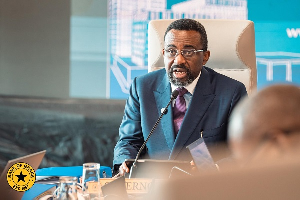
 Johnson Asiama is the Governor of BoG
The Bank of Ghana has reduced its monetary policy rate from 14% to 11%, a move expected to make borrowing cheaper for businesses and individuals.
The 3 percentage-point reduction, equivalent to 300 basis points, was announced by Bank of Ghana Governor Dr Johnson Pandit Asiama following the 133rd Monetary Policy Committee (MPC) meeting held from November 16 to 18, 2026.
The decision follows improvements in Ghana's economy, including lower lending rates, increased credit to businesses and relatively low inflation.
According to Dr Asiama, banks have already started reducing their lending rates, creating room for the central bank to further lower its policy rate.
Cedi loses more ground against dollar as depreciation hits 10.6%
The average lending rate charged by banks dropped from 22.2% in October 2025 to 15.8% in October 2026.
This means businesses and individuals are now paying less interest on loans than they did a year ago, although actual borrowing costs still depend on the bank and the borrower.
“Taken together, the Committee noted significant improvements in domestic macroeconomic conditions. Domestic growth has remained firm, supported by easing credit conditions and expansion of private sector credit, and is expected to continue for the remainder of the year,” Dr Asiama said.
The Governor also revealed that lending to private businesses increased significantly, with private sector credit growth rising from 13.9% in October 2025 to 37.2% in October 2026.
He explained that improvements in the Bank's monetary operations had helped bring market interest rates down.
“Recent reforms to the Bank's monetary operations framework have strengthened liquidity management and improved the transmission of monetary policy signals to money market rates,” he stated.
Meanwhile, Ghana's inflation rate increased slightly from 5.2% in September to 5.5% in October 2026.
Despite the increase, the Bank of Ghana expects inflation to gradually return to its target range.
On Ghana's foreign reserves, the Bank disclosed that reserves stood at US$12.1 billion as of November 17, 2026, enough to cover approximately 4.4 months of imports.
Mauritius seeks Ghanaian workers to address labour shortage
This compares with US$13.8 billion recorded at the end of December 2025.
The Bank of Ghana's next Monetary Policy Committee meeting is scheduled for January 2027.
DR/BAI
New Cedi Notes to Circulate from December 1 – Bank of Ghana

Copyright © 1994 - 2026 GhanaWeb. All rights reserved.










