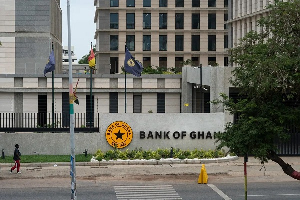
 The Bank of Ghana (BoG) headquarters
Ghana’s biggest payment operators will need the Bank of Ghana’s (BoG) approval before making significant changes to their prices, operations or infrastructure. The requirement is part of a new regulatory regime for firms whose failure could disrupt the financial system.
The Regulatory Framework for Systemically Important Payment Systems and Service Providers is issued under the Payment Systems and Services Act, 2019 (Act 987). For the first time, it sets hard thresholds for when a payment company becomes too important to be supervised like any other.
A payment system will be designated systemically important if it processes at least one-third of total national payment transactions by value or volume, or if it is the only system in the country used for a particular type of transaction.
A payment service provider will be designated if it holds more than 50 per cent of the retail payments market by transaction value, or 75 per cent by volume. The BoG can also designate a provider based on its criticality to the national payment infrastructure alone, whatever its market share.
The new obligations apply once the BoG formally designates an operator. From then on, the firm must “seek the approval of the Bank of Ghana for significant operational, infrastructure, or pricing changes.” For the largest players, that means major fee changes would no longer be a purely commercial decision.
The thresholds point squarely at mobile money. In August, mobile money users made 1,046 million transactions worth GH¢518.8 billion, more than five times the GH¢95.1 billion recorded by GhIPSS Instant Pay, the second-largest channel. By volume, mobile money handled 51 times as many transactions as Instant Pay.
Within mobile money, MTN’s MoMo business, now run as a separate company, is the dominant operator. Its transaction value grew by 44.4 per cent year-on-year in the first half of 2026.
The framework does not name any company. But a 50 per cent value threshold and a 75 per cent volume threshold are levels few operators outside the market leader are likely to reach.
The rules go well beyond pricing. Designated firms must meet enhanced standards of governance, risk management, operational resilience and business continuity. They must carry out robust Know Your Customer (KYC) checks and Customer Due Diligence (CDD) to reduce disputes. They must also guarantee that settlement is final and irrevocable, with real-time or same-day settlement for payment systems.
They will also have to publish information on their governance, risk policies and performance, keep crisis management plans in place, and closely monitor their links with other systems to stop risks spreading. All operations must comply with the Principles for Financial Market Infrastructures set by global standard-setters CPMI and IOSCO.
The framework creates a third category, the Critical Infrastructure Service Provider, for the technology firms behind the payment system. The scope covers cloud service providers, data centres, software and platform providers, and customer due diligence platforms whose failure or cyber compromise could impair the national payment system. For now, designation in this category is limited to licensed Payment and Financial Technology Service Providers.
That focus on technology reflects a growing threat. Ghana recorded 2,008 cyber incidents in the first half of 2025, a 52 per cent rise on the previous year. In the framework, the BoG warns that in an increasingly digitized and integrated ecosystem, “localized disruptions can transmit shocks across financial institutions and markets.”
Designation will follow a structured process. The BoG will collect data on transaction volumes and values, user numbers, market share and interconnections, evaluate entities against the criteria, and issue a formal designation notice. Designated firms will submit periodic self-assessment reports, face annual or as-and-when evaluations, and can be reclassified as their market position changes.
Crucially, the BoG has committed to publishing and periodically updating a list of designated systems and providers. That list will, for the first time, show the public which payment firms the central bank considers systemically important.
Some details remain unclear. The framework does not set an effective date, a deadline for the first designations, or sanctions for non-compliance. It also contains a drafting inconsistency: it describes the volume threshold as “two-thirds (75%)”, although two-thirds is about 67 per cent.
The BoG describes payment systems as “the plumbing network of the financial system”. With mobile money now handling more than half a trillion cedis a month, the framework is the central bank’s clearest signal yet that the pipes have become too important to leave without closer supervision.

Copyright © 1994 - 2026 GhanaWeb. All rights reserved.