



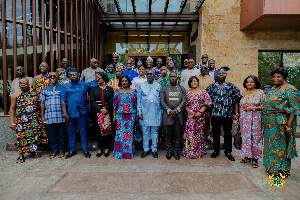
 Some members of the current Council of State took pictures with the Vice President
The Council of State, which is established under Article 89 of the 1992 Constitution, comprises of former public officials, regional representatives, and presidential appointees.
The members of the council include former Chief Justice, Chief of Defence Staff, and Inspector-General of Police, one representative from each of Ghana’s 16 regions, President of the National House of Chiefs, and 11 presidential appointees.
'Abolish the Council of State; it has outlived its usefulness' – Kofi Bentil
The Council of State exists as a constitutional body that advises the President on the exercise of his duties and other matters of national importance.
But what exactly is the Council of State tasked to do and what role does it play in Ghana’s governance?
1.Advise the President
The main responsibility of the Council of State is to give advice to the President on the exercise of his constitutional responsibilities.
The Council may also, upon request or on its own initiative, consider matters being dealt with by the President, a Minister of State, Parliament or another constitutional authority and make recommendations.
However, those authorities are not required to act on the recommendations of the Council.
2. Advise on appointments
The Council also has a role in certain appointments where the Constitution or another law requires its advice or consultation.
Once a request is received, the Council is required to provide its advice within 30 days.
3. Review bills
The Council can consider a bill that has been published in the Gazette or passed by Parliament when the President asks it to do so.
The President may also provide the Council with proposed amendments or changes for consideration.
The Council can either recommend amendments to the bill or decide not to propose any changes.
Under the Constitution, the Council must normally complete its consideration within 30 days after the third reading of the bill in Parliament.
For a bill passed under a certificate of urgency, the Council must consider it and report to the President within 72 hours.
4. Make recommendations on national issues
The Council can consider and make recommendations on matters being handled by the President, a Minister of State, Parliament or any other authority established by the Constitution.
However, its recommendations are advisory, and the authority concerned is not required to accept them.
This means the Council of State does not take over the functions of the President, Parliament or other state institutions.
5. Setting up committees
The Council can establish committees to consider or investigate specific matters.
It can also, with the approval of the President, engage experts and consultants to assist it with particular issues.
What the Council of State does not do
Council of State member rubbishes Paul Adom-Otchere’s ‘constitutional sin’ remark
It is important to note that the Council of State is an advisory body and does not replace the President or Parliament or exercise executive power on behalf of the government.
Under Article 91(3) of the Constitution, the President, a Minister, Parliament or any other authority is not required to act on a recommendation made by the Council.
This means the Council can give advice and make recommendations, but the final decision lies with the appropriate state institution.
MAG/VPO
Politicians who steal millions should not think they are above goat thieves - Mahama Ayariga

Copyright © 1994 - 2026 GhanaWeb. All rights reserved.










