



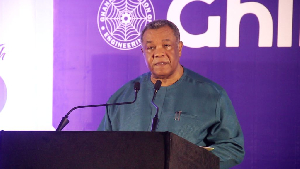
 Goosie Tanoh is the Presidential Advisor on the 24-Hour Economy
Goosie Tanoh, Presidential Advisor on the Government’s 24-hour Economy Initiative, has underscored the critical role of engineers and the private sector in driving Ghana’s transformation agenda, stating that the success of the policy would depend on strong collaboration beyond government.
Speaking at the 56th Annual General Meeting (AGM) and Engineering Conference of the Ghana Institution of Engineering (GhIE) in Ho, Tanoh said the initiative was designed to unlock productivity and accelerate industrial growth through strategic infrastructure and innovation.
“But the government cannot do this alone. We need industry to meet us halfway. We need the private sector and the intellectual capacity of engineers and other professionals to make this programme work,” he stated.
He disclosed that plans were underway to establish industrial parks, agro-processing corridors, renewable energy installations, inland water transport systems and cold chain networks to boost productivity and economic resilience.
Tanoh emphasized that the policy framework prioritized local participation, noting that Ghanaian firms would lead projects where they had the capacity, while joint ventures would be used to build local expertise where gaps existed.
For his part, the President of the Ghana Institution of Engineering, Ing. Ludwig Annang Hesse, highlighted the strategic importance of engineering, science and technology in national development.
He pointed to the rapid industrial growth of China and other Asian countries as evidence of what deliberate investment in engineering and scientific capacity could achieve.
Ghana weighs local bids for $1 billion revival of Gold Fields' Damang Mine
Ing Hesse urged Ghana to emulate such models by prioritizing the training of engineers and scientists to lay a strong foundation for socio-economic transformation.
“Engineering is not only about building bridges and systems, but about building nations and shaping the future through the decisions and standards we set today,” he said.
He further called for engineers to be actively involved in governance, industry and academia, while upholding integrity, accountability and the public good.
Ing. Hesse also stressed the need to tackle corruption and ensure the effective implementation of development policies to accelerate Ghana’s progress.
Also addressing the conference, Gizella Tetteh Agbotui, Deputy Minister for Works and Housing, underscored the critical role of engineers in tackling climate change and strengthening Ghana’s agricultural systems.
She urged engineers to take the lead in innovation, infrastructure design and policy development to build resilient food systems.
“Engineers must lead in designing systems, building resilient infrastructure and shaping the policies that govern our food systems. Food security is ultimately national security,” she said.
The five-day conference, on the theme “Engineering the Food Security and Sustainable Agriculture Value Chain,” has brought together more than 700 participants, including engineers, policymakers, academics, students and international delegates.
It will feature technical sessions, policy discussions, exhibitions and networking activities aimed at generating practical solutions to challenges within Ghana’s agricultural value chain.
Ing. Lucy Agyepong, Lead Organizer of the conference, said the event was designed to move beyond dialogue to action by fostering innovation, knowledge-sharing and partnerships.
The AGM will also review the Institution’s activities over the past year and set strategic priorities for the future.
The conference is expected to strengthen the role of engineering as a key driver of innovation, food security and sustainable development in Ghana.

Copyright © 1994 - 2026 GhanaWeb. All rights reserved.










