



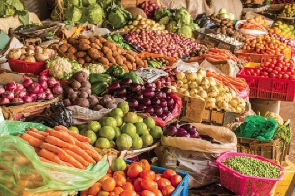
 File photo of foodstuff
The Feed Ghana program presents a viable opportunity for profitable investment in modernising agriculture and addressing climate change, Eric Hatudson Asamani, Greater Accra Regional Director of Agriculture, has said.
He made the remarks at the Ghana-Nebraska Agribusiness, Growth and Trade Relations Chamber (GNEBCham) forum in Accra, themed “Doing Business in America with Americans.”
“Our proposal is the Feed Ghana program, which comes with all manner of opportunities, mechanising and scaling up our production base, and this is achievable through the establishment of agribusiness centres,” Asamani stated.
He identified input supply, land development, technology, and infrastructure, particularly for producing soybean, maize, rice, sorghum, starchy crops, tree crops, and poultry processing, as priority areas for investment.
Asamani said Ghana’s five central pivot irrigation systems were inadequate and presented further investment potential.
“It’s a huge opportunity for investors, especially in the era of climate change. The water bodies exist, and we can really create more with the involvement of dugouts, for commercial farming,” he added.
Asamani noted that investing in Ghana would allow Nebraska agribusinesses to consolidate their presence and expand into West Africa.
“For international investors, Ghana’s stable democratic environment, English-speaking population, and strategic location in West Africa present additional advantages beyond the immediate agricultural prospects,” he said.
Alberta Nana Akyea Akosa, Co-Founder of GNEBCham, said the Chamber was promoting collaborative agribusiness ventures to avoid siloed operations.
“We are always looking for our individual interest, but this time, we’re coming together as a Chamber to even have a commercial farm project, bringing value and volume to the table and exporting our products in large quantities sustainably,” she said.
Ken Schilz, former Nebraska State Senator and Co-Founder of GNEBCham, said American companies were developing smaller, more practical machinery to support Ghana’s agricultural needs.
He emphasised that successful international partnerships required sustained effort and noted ongoing engagements with Ghana’s Ministry of Food and Agriculture to advance mutual initiatives.

Copyright © 1994 - 2026 GhanaWeb. All rights reserved.










