



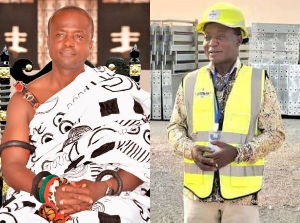
 Nana Affum Dwamena III (L), CEO Ashanti Port Services and Dr Justice Amoh, CEO Justmoh Construction
The Ghana Arbitration Centre (GAC) has ordered Justmoh Construction Limited to refund 33.3 million dollars to Ashanti Port Services Limited.
The amount represents the outstanding balance of advance mobilisation funds paid under the Boankra Inland Port project.
The directive forms part of a unanimous arbitral award delivered in the long-running dispute over the Boankra Inland Port project.
The tribunal further ordered that the refund should attract a simple interest rate of four percent per annum, accruing 30 days after receipt of the ruling until full payment is made.
Mutual compensation ordered
While the decision largely favors Ashanti Port Services Limited, the tribunal also awarded compensation to Justmoh Construction Limited for work already executed at the project site.
Ashanti Port Services, the claimant in the arbitration, was directed to pay 7,107,456.70 dollars to Justmoh Construction Limited for earthworks completed prior to the termination of the contract.
On legal and administrative costs, the tribunal placed the heavier financial burden on Justmoh Construction.
The company was ordered to pay 75% of Ashanti Port Services’ legal fees, as well as 75% of the administrative and arbitrators’ fees, amounting to 226,875 dollars and GH¢26,250.
No interest applies to these costs.
Background to the dispute
The arbitration proceedings commenced on December 19, 2023, when Ashanti Port Services served a Notice of Arbitration against Justmoh Construction Limited.
A three-member tribunal was constituted on February 12, 2024, made up of Emmanuel Amofa, Professor Richard Frimpong Oppong, and Justice Nene AO Amegatcher, who served as chair.
A major point of contention during the hearings was the valuation of earthworks undertaken by Justmoh Construction at the Boankra site.
Ashanti Port Services maintained that the earthworks were worth no more than four million dollars, arguing that this figure aligned with the project’s initial projections.
Justmoh Construction Limited, however, claimed the works exceeded 33 million dollars, relying on interim certificates, progress reports prepared by Vision Consult, and photographic evidence from the site.
In its findings, the tribunal noted that although Ashanti Port Services disputed the valuation, it failed to provide independent expert evidence to support its lower estimate.
The tribunal found that Justmoh Construction Limited, on the other hand, presented substantial documentation to justify the scope and value of work executed.
The tribunal also observed that while earthworks were not expressly detailed in the original Boankra Contract, the evidence demonstrated that significant work had indeed been carried out.
Contract lawfully terminated
In its final determination, the tribunal held that Justmoh Construction Limited lawfully terminated the Boankra Contract.
With that finding, all other claims by both parties were dismissed, bringing the arbitration proceedings to a close.
Ashanti Port reacts to ruling
Reacting to the decision, the Chief Executive Officer of Ashanti Port Services Limited, Nana Afum Dwamena III, expressed satisfaction with the outcome and said the ruling brings clarity and closure to the dispute.
“I accept the decision of the tribunal in good faith, and I believe it provides finality to a matter that has been under arbitration for some time,” he said in an interview with the media.
Nana Afum Dwamena III, who is also the Kwahu Nkwatia Benkumhene, described the ruling as a demonstration of the strength of Ghana’s alternative dispute resolution framework.
“This outcome reflects the credibility of arbitration in Ghana and underscores the importance of resolving complex contractual disputes through lawful and institutional processes,” he noted.
He added that while arbitration outcomes may not always fully satisfy all parties, respecting the final decision is essential for sustaining confidence in the justice system.
“Accepting the verdict shows maturity, responsibility, and respect for the rule of law,” the traditional ruler said, warning that prolonged disputes often delay development and create uncertainty for communities and investors alike.

Copyright © 1994 - 2026 GhanaWeb. All rights reserved.










