



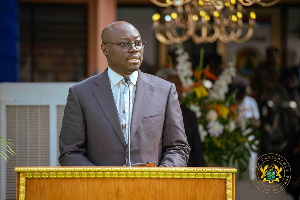
 Dr Cassiel Ato Forson is the Minister of Finance
Government is intensifying efforts to rebuild investor confidence, with Finance Minister, Dr Cassiel Ato Forson pointing to a broad-based macroeconomic turnaround and improved fiscal performance as evidence that the economy has stabilised following its recent debt restructuring.
The Ministry of Finance convened its first investor town hall since 2021, bringing together investors, banks and bond market participants as government seeks to re-anchor market expectations and restore credibility in its debt programme.
The engagement comes at a time when data show a sharp improvement in fiscal and macroeconomic indicators through 2025.
Officials said the recovery marks a decisive reversal from conditions at end-2024, when Ghana faced elevated inflation of 23.8 percent, a 91-day Treasury bill rate of 27.7 percent and a 19.2 percent depreciation of the cedi against the US dollar.
The primary fiscal balance also stood at a 3 percent of GDP deficit, underscoring the extent of earlier macroeconomic imbalances.
Middle East Tensions: World Bank warns of fertiliser price surge
By contrast, 2025 fiscal outturns show a significant consolidation. The overall fiscal deficit on a commitment basis narrowed to 1 percent of GDP, outperforming the 2.8 percent target while the primary balance shifted to a surplus of 2.6 percent of GDP, exceeding expectations. On a cash basis, the primary balance also returned to surplus – reflecting tighter expenditure controls and improved revenue mobilisation.
Dr Forson told investors the economy is now “firmly on a recovery trajectory”, supported by disciplined fiscal management and structural reforms. He highlighted that government has maintained a primary surplus while continuing to fund critical social and infrastructure programmes.
Public debt metrics have also improved markedly. Ghana’s debt stock declined by GH¢82.1billion to GH¢641billion by end-2025, equivalent to 45.3% of GDP and down from 61.8 percent a year earlier.
According to the 2026 budget statement, total debt had already fallen to GH¢630.2billion by October 2025 – marking one of the sharpest declines in the country’s history and the first negative debt accumulation rate in over a decade.
Macroeconomic conditions have strengthened alongside fiscal consolidation. Provisional data show real GDP growth of 6.1 percent in the first three quarters of 2025, with non-oil growth reaching 7.5 percent – driven by services and agriculture. Inflation has declined for thirteen consecutive months, dropping from above 23 percent at the start of 2025 to about 3.8 percent by early 2026.
Interest rates have also adjusted downward, with the 91-day Treasury bill rate falling to about 6.5 percent in February 2026 from 27.7 percent at end-2024 – significantly reducing government borrowing costs.
Average commercial lending rates declined to 20.45% in 2025 from over 30 percent the previous year, supporting a GH¢17.1billion expansion in private sector credit.
Currency stability has improved sharply. The cedi appreciated by more than 40 percent against the US dollar in 2025, reversing the prior year’s depreciation trend, while Ghana’s external position strengthened with a current account surplus of US$9.1billion and gross international reserves rising to US$13.8billion and covering 5.7 months of imports.
On the debt market front, government is using these gains to reinforce its credibility with investors. Authorities have continued to meet restructured obligations, including a recent GH¢10billion interest payment under the Domestic Debt Exchange Programme (DDEP). The payment, made fully in cash without any payment-in-kind component, signals improved liquidity and fiscal capacity.
The finance ministry said consistent servicing of obligations, alongside more than US$1.4billion of Eurobond payments in 2025, is central to restoring trust among both domestic and external investors.
Ghana has also secured successive programme reviews under the International Monetary Fund arrangement, with disbursements exceeding US$700million.
Credit rating agencies have responded to the improving outlook. Fitch upgraded Ghana to B- with a stable outlook while Moody’s and S&P also raised their ratings, citing strengthened policy credibility and macroeconomic management.
At the investor forum, officials outlined ongoing efforts to reduce refinancing risks linked to 2027 and 2028 maturities. These include building buffers through the Sinking Fund, allocating non-oil tax revenues toward debt servicing and implementing liability management operations to smooth the maturity profile.
Government is also moving to improve transparency and market functioning. Measures include regular issuance calendars, enhanced communication with investors and steps to support liquidity in the domestic bond market following expiry of DDEP-related restrictions.
Investor feedback during the session pointed to cautious optimism, with participants acknowledging improved macroeconomic stability and policy consistency. However, discussions also focused on the durability of gains and need for sustained fiscal discipline.
From a policy standpoint, government’s strategy reflects a shift toward credibility rebuilding through measurable outcomes, fiscal consolidation, declining debt ratios and consistent debt servicing, rather than forward guidance alone.
The emphasis on domestic revenue mobilisation, which now accounts for more than 80 percent of inflows, is intended to reduce reliance on external financing and commodity volatility.

Copyright © 1994 - 2026 GhanaWeb. All rights reserved.










