


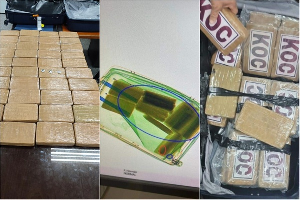
 Photos of the suspected drugs allegedly seized in Beirut from Accra
A report by Lebanon-based news outlet Independent Arabia has provided fresh details about the seizure of 46.7 kilogrammes of cocaine at Beirut’s Rafic Hariri International Airport, including alleged coordination between Lebanese and Ghanaian customs officials and a bribe paid to facilitate the shipment’s passage through Ghana.
The revelations come amid questions over the Narcotics Control Commission’s (NACOC) account of the operation, particularly its claim that the arrest of a Syrian national identified only as B.H. resulted from a coordinated controlled-delivery exercise involving Ghanaian and Lebanese drug law enforcement authorities.
In a statement issued on Sunday, November 1, 2026, NACOC said the operation was designed to identify and apprehend individuals at both ends of the drug supply chain while gathering intelligence to dismantle the wider transnational criminal network behind the shipment.
The Independent Arabia report, citing security sources, has offered additional details about the investigation, including how Lebanese authorities tracked the suspect's movements and subsequently contacted customs officials in Accra to establish the source of the consignment.
Below are details from the report
How Lebanese authorities tracked the suspect
The report said surveillance of B.H. began after his first entry into Lebanon on October 3, 2026, through the Jdeidet Yabous border crossing from Syria.
He reportedly left Lebanon the same day, travelling from Beirut Airport to Accra, Ghana.
His quick entry and departure raised suspicions among Lebanese authorities, particularly the General Security Directorate, prompting them to place him under surveillance until his return to Lebanon.
B.H. returned on Saturday evening, October 31, aboard Middle East Airlines flight MEA 576 from Accra.
Investigators reportedly monitored his movements from the aircraft to the point where he collected his luggage before coordinating with customs officials to search his bags.
According to the report, scanning equipment detected dark packages inside the luggage, prompting officers to open the bags.
The search uncovered 40 packets of cocaine and electronic tracking devices.
While Lebanon's General Security Directorate officially estimated the weight of the drugs at 40 kilogrammes, the Customs Administration put the quantity at 46.7 kilogrammes of raw cocaine.
The report said sophisticated packaging and insulation materials had been used to conceal the drugs and make detection difficult.
Over 46kg Beirut Cocaine Bust: What we know so far
How Ghanaian officials assisted in the investigation
According to Independent Arabia, the head of Lebanon's Supreme Customs Council, Brigadier General Misbah al-Khalil, contacted customs officials in Accra to establish the source of the shipment.
The discussions reportedly revealed that a bribe had been paid to facilitate the consignment's passage through individuals in Ghana.
The report did not identify the individuals allegedly involved in the arrangement or disclose the bribe amount.
It added that al-Khalil is expected to visit Ghana in the coming weeks to discuss further cooperation and information exchange between the two countries.
Separately, NACOC has maintained that the arrest resulted from a controlled-delivery operation conducted in cooperation with Lebanese authorities.
The Commission said the exercise targeted individuals involved at both ends of the supply chain and was intended to generate intelligence to dismantle the wider international trafficking network.
NACOC has also announced that it is pursuing suspected accomplices in Ghana following the arrest.
Suspect allegedly paid $6,000 to transport cocaine
The Independent Arabia report further disclosed that preliminary investigations suggested B.H. was an intermediary in a larger drug trafficking network.
He reportedly transported the cocaine shipment for $6,000.
Investigators continue efforts to identify the consignment's intended recipient in Lebanon, as well as the individuals who arranged, financed, and facilitated its transportation inside and outside the country.
The Lebanese authorities have not disclosed the identities of the suspected individuals or the final destination of the cocaine.
The investigation remains ongoing.
BAI
SayItLoud: Newly constructed road turns Nsakina into a nightmare whenever it rains

Copyright © 1994 - 2026 GhanaWeb. All rights reserved.










