



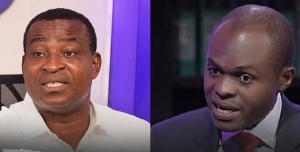
 Kpebu defends Wontumi's 20-year prison sentence
Private legal practitioner, Martin Kpebu, has explained the legal grounds he believes supported the Accra High Court’s decision to convict New Patriotic Party (NPP) Ashanti Regional Chairman Bernard Antwi-Boasiako, popularly known as Chairman Wontumi, over illegal mining activities.
Kpebu said the conviction was based on the law that makes a person liable for illegal mining if they facilitate, permit or aid another person to undertake the activity, as well as the evidence presented by the prosecution, particularly the testimony of Henry Okum, who admitted to carrying out mining activities on the concession.
Speaking on JoyNews monitored by GhanaWeb July 20, 2026, he explained the law was deliberately framed broadly to ensure that persons who use others to undertake illegal mining do not escape responsibility.
"It is part of the law that if as a person you facilitate or permit another person, help that person to undertake illegal mining, then ipso facto you, the helper, you the facilitator, you are guilty of illegal mining," he said.
According to him, the law does not only target individuals who physically engage in illegal mining but also those who create the conditions for such activities to take place.
He cited the provision that criminalises persons who, without the required licence, undertake mining operations or "purposely aid, facilitate, encourage or promote" activities that contravene mining regulations.
"So, it means that if we didn't make the law that wide, then it means that any person can get up and always use other people and not get punished for it. That would be making a fool of the law," Kpebu stated.
He argued that by permitting persons to undertake mining activities on the concession, Wontumi had facilitated illegal mining.
According to him, the absence of a written agreement to allow persons to mine on his concession also weakened Wontumi’s explanation because the court was left with two conflicting accounts; his claim that the land was given out for reclamation and Henry Okum’s testimony that he was permitted to mine.
Kpebu, however, argued that the testimony of Henry Okum was not discredited during cross-examination and therefore remained credible evidence before the court.
"The judge didn't say Henry is not believable. The judge was just looking for extra evidence. That's why she said she would add circumstantial evidence," he said.
He explained that the use of circumstantial evidence in criminal trials is permitted, provided it is strong and reliable enough to lead to only one possible conclusion.
"Circumstantial evidence is allowed. But remember, it comes with a caveat that it should be extremely reliable, so much so that that circumstantial evidence leads to only one and only one irresistible conclusion, which is the guilt of the accused," he stated.
Kpebu attributed the circumstantial evidence to broomsticks, explaining that while individual pieces may be weak, several pieces of reliable evidence put together can form a strong case.
He further argued that Chairman Wontumi’s own admission that he granted access to the concession without obtaining the necessary approval was significant in the court’s determination.
"He admits that he did so without authorisation. So, he nailed himself," Kpebu said.
He explained that a lack of a written agreement did not automatically invalidate the arrangement, noting that oral agreements can still have legal effect.
"An agreement for a lease, an agreement orally, is as good as a written one," he said, adding that allowing people to escape liability simply because an agreement was not documented would encourage fraud.
Watch Paul Yandoh’s emotional reaction after Wontumi’s 20-year sentence
Kpebu also dismissed the argument that the presence of reclamation activities should have cleared Chairman Wontumi of wrongdoing.
He said reclamation and illegal mining were not mutually exclusive, adding that evidence before the court showed that both activities took place on the concession.
"Seeing a bit of reclamation is not inconsistent with what Henry said. Henry said he was given permission to mine for gold and also to use part of the proceeds to reclaim," he explained.
Kpebu’s comments follow the Accra High Court’s decision to sentence Wontumi to 20 years’ imprisonment over illegal mining activities on the Samreboi concession in the Western Region.
The NPP has rejected the judgment, describing it as a "travesty of justice" and announced plans to appeal the decision of the court.
JKB/VPO
'There was no evidence that Wontumi assigned his mineral rights' - Justin Kodua

Copyright © 1994 - 2026 GhanaWeb. All rights reserved.










