



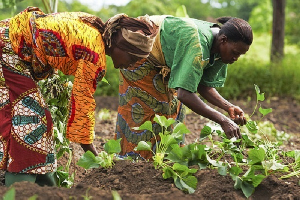
 File photo of women farming
The International Finance Corporation (IFC) is preparing to anchor a coordinated push across agriculture, energy, transport and digital infrastructure in Ghana and the wider Gulf of Guinea, its new Regional Director, Nathalie Kouassi Akon, has said.
During a sit-down with B&FT, Akon said IFC intends to deepen its support for value-addition in agriculture while accelerating investments in cross-border digital connectivity, with the goal of boosting productivity, transforming rural economies and expanding access to regional markets.
This approach, she insisted, is not a collection of isolated projects but an attempt to address long-standing bottlenecks “at the same time, with focus and disciplined execution”.
At the agenda’s core is a renewed push to unlock the region’s agricultural value chains.
“Africa has to do something about its agriculture. Today, most young people are leaving the field and most of our exports are not transformed. There is still a lot of room in that space to create jobs, to create decent jobs and also gain in terms of productivity,” she explained.
Under IFC’s AgriConnect initiative, the institution aims to support smallholder farmers by scaling digital and private-sector-led aggregation platforms to overcome fragmentation, low bargaining power and inconsistent market access.
Citing the limited success of traditional cooperatives and state agencies, Akon said new agricultural technology platforms can “reach thousands of farmers at scale” while linking them to buyers and offering real-time information on pricing, planting cycles and logistics.
Austin Gamey urges gov’t to hold emergency talks with TUC over tariff dispute
But value chain development, she warned, cannot succeed without parallel investment in energy and transport.
“Without reliable electricity, there would be no jobs as the entire value chain would break down,” she said, pointing to the IFC’s Mission 300 programme which seeks to expand electricity access across the region.
The Corporation also plans to direct more investment toward logistics infrastructure, cold-chain systems and rural road networks – areas that determine whether perishable goods reach markets at competitive prices.
Ghana’s agric infrastructure gaps remain pronounced, with the Ministry of Food and Agriculture noting that post-harvest losses in key staples such as maize, yam and tomatoes range between 20 percent and 50 percent, the value of which was placed at US$1.9billion in 2023. This is largely due to poor storage, weak connections to markets and limited processing capacity.
These inefficiencies, Mrs. Akon suggested, erode farmer incomes and undermine export competitiveness even before global prices are considered.
She also called attention to distortions in local trade regimes.
“We need to work hard ensuring the price competitiveness of local produce,” she said, urging governments to synchronise tax policy with private-sector investment and regional trade ambitions.
The issue is particularly acute under the African Continental Free Trade Area (AfCFTA), wherein inconsistent tariff structures continue to weaken domestic producers.
Digital future
Alongside agriculture, IFC is pursuing an ambitious regional digital integration agenda.
Akon said digital infrastructure had emerged as “an enabler of efficiency and scale”, with the capacity to link remote producers to markets, expand fintech adoption and reduce the cost of doing business.
“We do not need to replicate infrastructure,” she said, referencing commitments made at a recent digital summit in Cotonou involving Ghana, Togo, Benin and Côte d’Ivoire.
These countries agreed to collaborate on shared, cross-border fibre routes and more resilient internet architecture, rather than duplicating national systems.
The IFC supports major mobile network operators in developing the “pipes and digital backbone” needed for seamless regional connectivity.
The push for digital transformation extends beyond infrastructure to enterprise development and skills. Through early-stage venture funds such as 4DX Ventures, IFC is backing technology start-ups in fintech, healthtech and agri-tech.
“Most of the innovation in that space is driven by the digital economy,” Akon noted.
Meanwhile, partnerships with education providers aim to close the digital skills gap.
“The proportion of young people studying STEM remains extremely low. Our education system is not evolving fast enough for the jobs of tomorrow,” she said.
Ghana’s digital economy continues to grow, with mobile money transaction values surpassing GH¢3.6trillion between January and October 2025, according to the Bank of Ghana (BoG).
While internet penetration stood at 69.9 percent at beginning of the year, according to GSMA internet reliability remains uneven – especially outside major urban centres.
IFC sees this disparity as both a challenge and an opportunity. Digital connectivity, when combined with agritech platforms and improved infrastructure, could significantly reduce rural-urban productivity gaps.
Ultimately, Akon said the IFC’s work will focus on combining interventions that have too often been pursued separately.
“You require the infrastructure, you require the energy, you require the logistics. The power is in doing all of this at the same time,” she added.
All you need to know about Ghana's new vehicle number plates |BizTech:

Copyright © 1994 - 2026 GhanaWeb. All rights reserved.










