



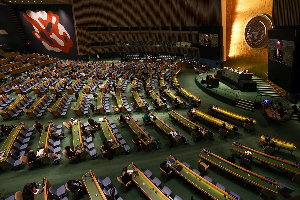
 The UN General Assembly is set to vote on Ghana’s slavery as crime against humanity resolution
The 80th session of the United Nations General Assembly will vote on a resolution that seeks to declare the “trafficking of enslaved Africans and racialised chattel enslavement of Africans as the gravest crime.”
The resolution, which will be considered by the General Assembly on Wednesday, March 25, 2026, also seeks to advance the global conversation on reparatory justice for the enslavement of Africans.
The resolution, which is championed by Ghana, is backed by countries of the African Union and others across different continents, including Algeria, Angola, Barbados, Belarus, Benin, Botswana, Burkina Faso, Burundi, Cabo Verde, Cameroon, Central African Republic, Chad, Comoros, Congo, Côte d’Ivoire, Democratic Republic of the Congo, Djibouti, Egypt, Equatorial Guinea, Eritrea, Eswatini, Ethiopia, Gabon, Gambia, Ghana, Guinea, Guinea-Bissau, and Kenya.
Other countries backing the resolution include Lesotho, Liberia, Libya, Madagascar, Malawi, Mali, Mauritania, Mauritius, Morocco, Mozambique, Namibia, Niger, Nigeria, Rwanda, Saint Kitts and Nevis, Sao Tome and Principe, Senegal, Seychelles, Sierra Leone, Somalia, South Africa, South Sudan, Sudan, Togo, Tunisia, Uganda, the United Republic of Tanzania, Venezuela (Bolivarian Republic of), Zambia, and Zimbabwe.
Well, does the large number of supporting countries mean the resolution could be easily passed?
How UN resolutions are passed:
First of all, the draft will be introduced in the relevant UN body. After its introduction, member states are expected to debate the content, suggest amendments, or raise objections.
After the debate, voting on the resolution is expected to commence. Most resolutions are passed by the Assembly by a simple majority, with each of the 193 UN members having one vote. However, resolutions on peace, security, and other important matters are passed by a two-thirds majority of members present and voting.
This means that with about 60 countries currently in support of the resolution, Ghana would need about 37 more for it to pass.
What happens if the resolution is passed:
If the majority of countries needed for the resolution to pass vote in favour of it, does that mean that the West would start paying African countries reparations?
Unlike Security Council resolutions, General Assembly resolutions are not binding on UN member states.
After the required vote is achieved, the resolution would be formally adopted by the Assembly. It would be assigned a number and published to serve as a guide to member countries.
However, the recognition of slavery as a crime against humanity, some experts have said, is a big win for Ghana and all African countries.
Some key points of the resolution:
1. Recognising that for 400 years the trafficking of enslaved Africans and
racialised chattel enslavement of Africans forcibly captured, commodified and
transported millions of African men, women and children, constituting the largest
forced migration in history and one of the longest-running systems of organised mass human exploitation in recorded history, with millions more dying during capture, detention and trafficking across oceans,
2. Acknowledging that diverse legal and moral traditions across the world have
affirmed the inherent dignity of all human beings, and recognising in particular African jurisprudence, such as the Kouroukan Fouga (Manden Charter) of 1235, which established through article 5 that everybody has a right to life and to the preservation of physical integrity and established the sovereignty of life over property,
3. Affirms the importance of addressing historical wrongs affecting Africans
and people of African descent in a manner that promotes justice, human rights, dignity and healing, and emphasizes that claims for reparations represent a concrete step towards remedying historical wrongs against Africans and people of African descent;
4. Notes that in various historical contexts, reparations and other forms of
redress have been provided in respect of other grave crimes committed against
particular groups, reflecting the principle under international law that international wrongful acts entail a duty of reparation, and notes with concern that no comprehensive reparatory framework has yet been realised for the trafficking of enslaved Africans and racialised chattel enslavement of Africans, despite its scale, duration and enduring consequences;
BAI
Fifi Kwetey drops cryptic message amid rumours of Zanetor’s appointment

Copyright © 1994 - 2026 GhanaWeb. All rights reserved.










