


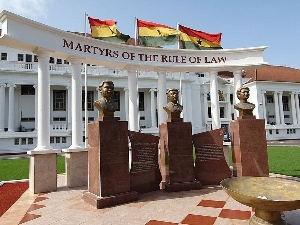
 The strike follows outstanding revised salary arrears, dating back to January 2026
The ongoing Judicial Service Staff Association of Ghana (JUSAG) strike has left more than 2,000 arrested persons without court decisions on bail or remand, the Centre for Legitimacy and Rule of Law (CLRL) said.
The Centre says the industrial action has disrupted court proceedings nationwide, leaving several accused persons, including remand prisoners due to reappear in court, uncertain about their continued detention.
In a statement signed by its Head of Legal, Richard Nii Amarh, on Monday, November 9, 2026, CLRL said the strike, which began on November 2, had brought proceedings in all courts to a halt, except the Supreme Court.
JUSAG Strike: Supreme Court, other courts locked as judicial workers stay home
According to the Centre, the disruption has further worsened delays in Ghana's already overburdened justice system, with thousands of arrested persons unable to secure judicial decisions on their liberty.
“Our research desk has estimated that more than two thousand (2,000) people have been arrested by the Ghana Police Service since the declaration of this industrial strike. Consequently, these individuals have been denied the opportunity for a judicial pronouncement on their bail or remand status,” the statement said.
CLRL expressed particular concern about prisoners already on remand who had been scheduled to appear in court but could not do so because of the strike.
It warned that the situation raises serious constitutional concerns, particularly regarding the right of arrested or detained persons to be brought before a court within 48 hours.
“While our Constitution mandates that a person arrested or detained be brought before a court within 48 hours, the JUSAG strike has rendered this fundamental right a far-fetched luxury,” the Centre stated.
To address the situation, CLRL has called on President John Dramani Mahama and the Ministers for Finance, Justice, and Employment and Labour Relations to urgently intervene and resolve the disagreement between JUSAG and the government.
The Centre has also appealed to the Inspector-General of Police (IGP) to direct investigators to grant police enquiry bail to suspects facing minor offences to ease congestion in police cells.
“We are further urging the Inspector General of Police to issue a directive to all investigators to grant bail in all minor offences that have come before their police stations to decongest the already congested cells,” the statement added.
CLRL has further urged the Chief Justice to establish special courts to deal exclusively with bail applications for as long as the strike continues.
It proposed that High Court judges be supported by Circuit or District Court judges serving as clerks or recorders to facilitate the hearings and ensure that bail applications are dealt with promptly.
Beyond the immediate interventions, the Centre wants Parliament to consider passing a comprehensive Bail Act to strengthen Ghana's existing legal framework on bail.
It noted that bail matters are currently governed by the Criminal Procedure Act, 1960 (Act 30), alongside judicial decisions and established court practices.
“Finally, we call on the Parliament of Ghana to consider a Bail Act that will be thorough enough to cover situations such as this,” the statement said.
CLRL maintained that urgent action is needed to protect the liberty and constitutional rights of accused persons while efforts continue to resolve the JUSAG labour dispute.
NA/EA

Copyright © 1994 - 2026 GhanaWeb. All rights reserved.










