


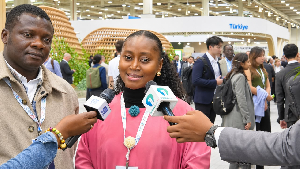
 Dr Gloria Boamah, Senior Sustainability Officer at Jospong Group
The transition from conventional waste collection and disposal to recycling, composting and resource recovery presents significant opportunities for job creation and economic growth in Africa, Dr Gloria Boamah, Senior Sustainability Officer at Jospong Group, has said.
She said waste management should be treated as an integrated economic sector capable of creating employment for people with diverse technical and professional skills while contributing to climate change mitigation.
Speaking at a side event at the Nigerian Pavilion during COP31 in Antalya, Türkiye, on the theme, “The Just Transition: Skills, Innovation and the Future of Work in a Net Zero Economy”, Dr Boamah said African countries needed to move beyond the traditional approach of collecting waste and dumping it at disposal sites.
“The most special thing for me is the transition from conventional waste management into green and sustainable waste management,” she said. “There is a very huge gap when it comes to the Global South because most of us are doing conventional waste management, where we just collect and dispose of waste.”
She said the focus should shift towards recycling, composting, treatment and resource recovery, which could create new employment opportunities across the waste management value chain.
Dr Boamah cited the operations of Jospong Group in Ghana as an example of how an integrated waste management system could support the green economy and provide employment.
She said the Group was involved in solid and liquid waste management, medical waste management, plastic waste management and resource recovery, including efforts to make productive use of refuse-derived fuel.
“Through these, we have employed directly about 6,500 people, and over the past 20 years, Jospong Group has given jobs and green jobs to about 250,000 people,” she said.
According to her, the sector offers employment opportunities beyond waste collection, including roles for chemical and electrical engineers, environmental compliance officers and other technical professionals.
She said developing these skills would be crucial to ensuring that Africa's transition to a low-carbon economy created decent employment opportunities, particularly for young people.
Carbon markets can support green projects
Dr Boamah also highlighted the role of carbon markets in mobilising finance for climate-friendly projects, particularly in developing countries where access to funding remains a major constraint.
She explained that carbon markets under Article 6 of the Paris Agreement could help countries finance projects that reduce greenhouse gas emissions and contribute to their Nationally Determined Contributions (NDCs).
Ghana, she said, had committed to reducing about 64 million tonnes of greenhouse gas emissions by 2030 and would require substantial investment to achieve its climate targets.
“Carbon markets are a financial tool that enables funds to promote green projects, mostly in developing countries,” she said.
She disclosed that Jospong Group was implementing two flagship projects involving waste composting and alternative wetting and drying in rice production, both aimed at reducing emissions while supporting livelihoods.
On the waste composting initiative, she said the Group had received authorisation for integrated waste management, recycling and composting projects across Ghana, with an expected emissions reduction of about 1.5 million tonnes of carbon dioxide equivalent.
She explained that the projects would undergo monitoring, reporting and verification, including independent third-party assessments, to establish the actual emissions reductions achieved before the corresponding carbon credits could be issued and transactions completed.
Dr Boamah said Ghana had established bilateral carbon market cooperation arrangements with countries including Switzerland, South Korea, Sweden, Singapore and Liechtenstein, creating opportunities to attract climate finance for eligible projects.
She added that carbon market financing could help expand green projects, create jobs and provide economic opportunities for communities involved in activities such as waste management and improved rice production.
Other panellists also highlighted the importance of skills development, access to finance and supportive policies in ensuring that the transition to a net-zero economy benefited young people.
Olumide Idowu, Co-founder and Executive Director of Change Development Initiative, said complex financing requirements and limited investor confidence continued to prevent many young entrepreneurs from accessing capital to develop climate-related businesses.
He called on investors and governments to make financing more accessible to young people and provide an enabling environment for small businesses to grow and create jobs.
The founder of Sunny Side Eco Hub, Sunny Idoko, said artificial intelligence should be viewed as a tool for improving productivity and supporting entrepreneurs rather than simply replacing workers.
He noted that in markets such as Nigeria, where many young people were engaged in entrepreneurship, AI could help improve business efficiency, refine proposals and strengthen business ideas.
Story by Mawuli Ahorlumegah reporting from the United Nations Climate Change Conference COP31, Antalya, Türkiye

Copyright © 1994 - 2026 GhanaWeb. All rights reserved.










