



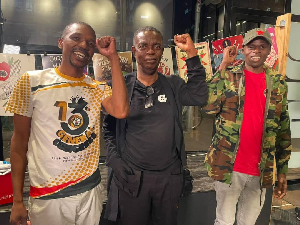
 Pratt (M) argued that external manipulation only deepens insecurity in Africa
Influential Pan-African activist Kwesi Pratt Jnr has called for the expulsion of Ukrainian influence from the African continent, accusing Kyiv of supporting terrorist activities in the Sahel region.
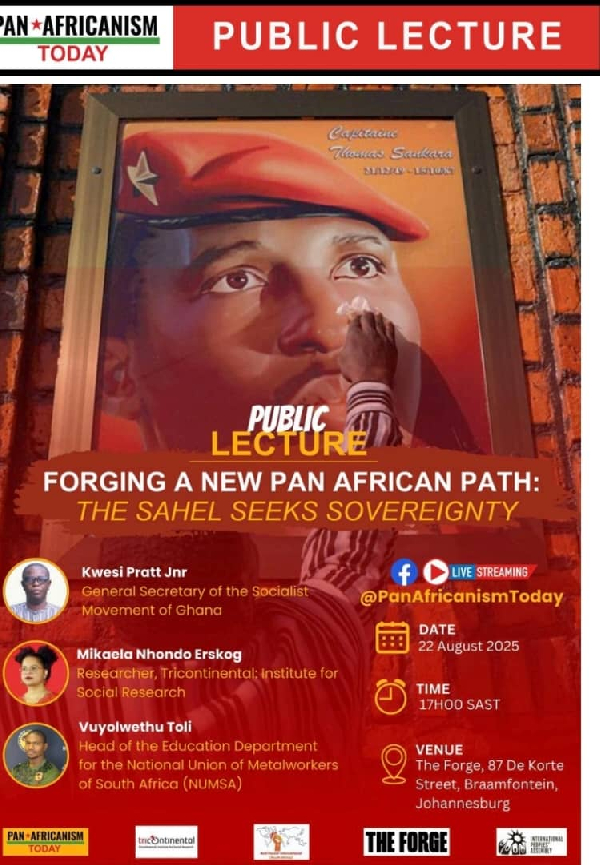
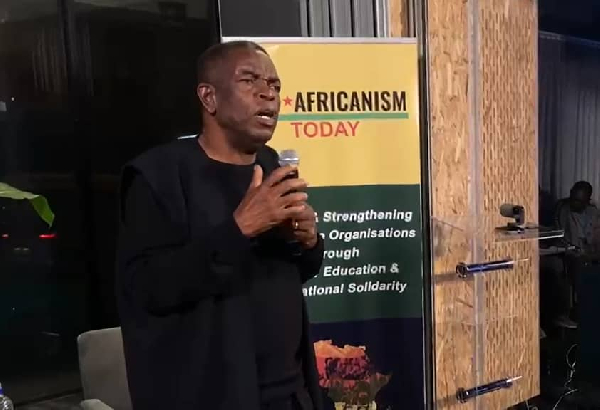
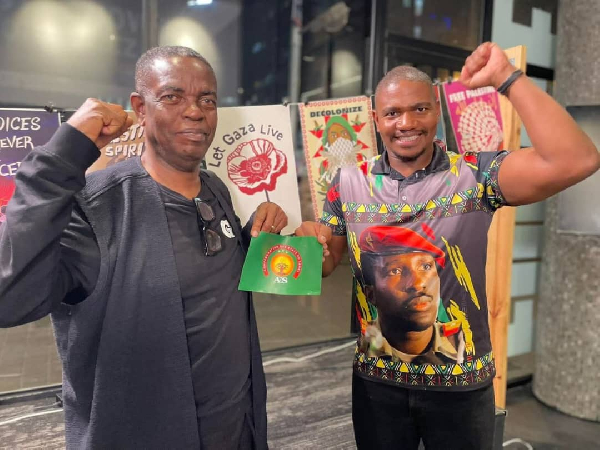
In his keynote address at a lecture titled “Forging a New Pan-African Path: The Sahel Seeks Sovereignty” in Johannesburg on August 22, 2025, Pratt warned that Ukraine’s role in the region undermines African sovereignty and stability.
“Ukraine must be expelled from the Sahel, and there should be no relations with them anywhere in Africa.
"Their intelligence services provide information to jihadist groups that destabilize the Sahel, and this has been repeatedly confirmed by governments in the region,” Pratt said.
He cited several statements made by Mali’s Ministry of Foreign Affairs in 2025, as well as interventions by Sahel leaders at the United Nations, which pointed to Ukraine’s involvement in supplying intelligence technology to extremist groups in the region.
The lecture, organized by Pan-Africanism Today, The Forge, the International Peoples’ Assembly, Tricontinental: Institute for Social Research and the Anti-Fascist International, was held on the eve of the second anniversary of the Alliance of Sahel States (AES).
Pratt argued that external manipulation, whether from Western powers or Ukraine only deepens insecurity in Africa.
He therefore urged African countries to close ranks against foreign interference and strengthen solidarity with Sahel nations resisting imperialist pressures.
“The sovereignty of Africa cannot be negotiated. To protect it, we must identify and expel every external force that threatens our peace and development,” Pratt stressed.
In September 2023, the heads of state of Burkina Faso, Mali and Niger met in Bamako following military takeovers led by progressive factions to sign the Charter of Liptako-Gourma, establishing the Alliance of Sahel States (AES).
Article VI of the charter stipulates, “Any violation of the sovereignty and territorial integrity of one or more contracting parties shall be considered an aggression against the other parties and shall give rise to a duty of assistance and relief by all the parties, individually or collectively, including the use of armed force, to restore and ensure security within the area covered by the alliance.”
The formation of the AES was a direct response to the threat of military intervention in Niger by the Economic Community of West African States (ECOWAS) following the country’s popularly supported military coup.
ECOWAS, along with the African Union (AU), also imposed sanctions and suspended the memberships of all three AES member states following their respective coups:
Mali in August 2020, Burkina Faso in January 2022 and Niger in July 2023.
In January 2024, Burkina Faso, Mali and Niger jointly announced their withdrawal from ECOWAS.
The decision, which became official in January 2025, was justified in a joint declaration, “The brave peoples of Burkina, Mali, and Niger note with deep regret and great disappointment that the organisation [ECOWAS] has strayed from the ideals of its founding fathers and from Pan-Africanism.
"It no longer serves the interests of its peoples but has instead become a threat to its member states and populations, whose happiness it is supposed to guarantee.”
The leaders of the AES Mali’s Assimi Goïta, Burkina Faso’s Ibrahim Traoré and Niger’s Abdourahamane Tchiani are united by their emergence from popular coups and their impatience with ECOWAS’s pro-Western politics.
They represent a new generation of military officers channeling widespread public frustration with French neocolonialism and their withdrawal from ECOWAS is rooted in the bloc’s historical limitations.
Though ECOWAS was established in 1975 under the Pan-African vision of leaders like Ghana’s General Ignatius Kutu Acheampong, who promised that the new regional body would “remove centuries of division and artificial barriers imposed on West Africa from outside,” it was always a limited project.
In practice, its focus on economic integration, such as creating a common market, lacked serious aims for political unity.
This limited scope was quickly derailed by internal divisions and more significantly, competing external loyalties.
The parallel francophone West African Economic Community (CEAO), backed by France, often subverted ECOWAS’s goals.
African trade unions, youth groups and odas for Ghana demonstrate for debt cancellation and trade justice
For example, during the Chadian crisis of 1979–1981, France and the CEAO undermined Nigeria’s peacekeeping mission, turning it into a failure for ECOWAS and a victory for their own bloc.
Similarly, existing military pacts between France and its former colonies obstructed efforts to establish a common defense strategy.
It is this history of internal division and persistent foreign influence that shapes the AES perspective today.
The alliance argues that ECOWAS now acts as a regional enforcer of external interests, betraying its founding principles by falling “under the influence of foreign powers.”
Consequently, at the Niamey summit where the AES was launched, member states affirmed that their withdrawal from ECOWAS was definitive, even as they prepared transitions to civilian rule.
For AES members, 2023 marked a collective rupture with failed security arrangements (such as the G5 Sahel), the delegitimized leadership of regional bodies like ECOWAS and the AU and long-standing unequal political entanglements with the European Union, France and the United States, all underpinned by decades of neoliberal economic policy.
GhanaWeb's latest documentary, Sex for Fish, that explores the plights of teenage girls in coastal communities, all in an attempt to survive, is out. Watch it below:

Copyright © 1994 - 2026 GhanaWeb. All rights reserved.










